The Trust Layer for Digital Customer Experiences in the Agentic Era
HUMAN brings visibility and control to every interaction across the customer journey, from first ad impression to final transaction, so real customers, partners, and trusted AI agents can move freely, but fraud, abuse, and bad actors can’t.
GET A DEMO












A Unified Platform for Trusted Digital Interactions and Transactions
Help stop sophisticated bot attacks and prevent cyberfraud with protection that stays ahead of evolving threats. Our proven platform minimizes false positives, builds customer trust, and safeguards millions in daily transactions for leading enterprises.

Advertising Protection
Initial bid request
Load ad
View ad
Click on ad








Application Protection
User visits website
Engages with content
Fill out form


Account Protection
User creates or logs in to account
Perform authenticated interactions


Transaction Protection
Transact
Use a promotion or credit card
Use loyalty points or a gift card


Advertising Protection
Initial bid request
Load ad
View ad
Click on ad
Application Protection
User visits website
Engages with content
Fill out form
HUMAN Use Cases
Account Protection
User creates or logs in to account
Perform authenticated interactions
HUMAN Use Cases
Transaction Protection
Transact
Use a promotion or credit card
Use loyalty points or a gift card
HUMAN Use Cases
The HUMAN Difference in Bot and Fraud Prevention
HUMAN’s unified platform prevents, detects, and responds to cyberthreats with unparalleled scale, speed, and decision precision to deliver a secure and trustworthy environment for your company and customers.
Scale
HUMAN verifies more than 20 trillion digital interactions weekly across 3 billion unique devices to provide unrivaled threat telemetry.
Speed
The HUMAN Decision Engine examines 2,500-plus signals per interaction, and connects disparate data to detect anomalies in mere milliseconds.
Decision Precision
Signals from throughout the customer journey are analyzed by 400-plus algorithms and adaptive machine-learning models to enable high-fidelity decisioning.

Unrivaled Threat Intelligence and Research
The HUMAN Satori Threat Intelligence and Research team sets us apart in safeguarding the digital world. As a collaborative force multiplier, it proactively uncovers threats, addresses vulnerabilities, and partners to disrupt cybercrime operations—delivering actionable and comprehensive insights.
10 Million
dollars
Phish ‘n’ Ships disrupted a fake shop operation that cost digital consumers millions of dollars.
10 Billion
fraudulent ad requests
At the peak of the Konfety investigation, malicious apps generated 10 billion fraudulent ad requests per day.
1 Million
infected devices
The BADBOX 2.0 operation infected more than a million consumer devices.


Validated by Analysts and Customers

HUMAN Named a Leader
As HUMAN enters a new phase of evolution, we are pleased to announce we received top scores possible across nine criteria in The Forrester Wave™: Bot Management Software Report, Q3 2024.
Learn More
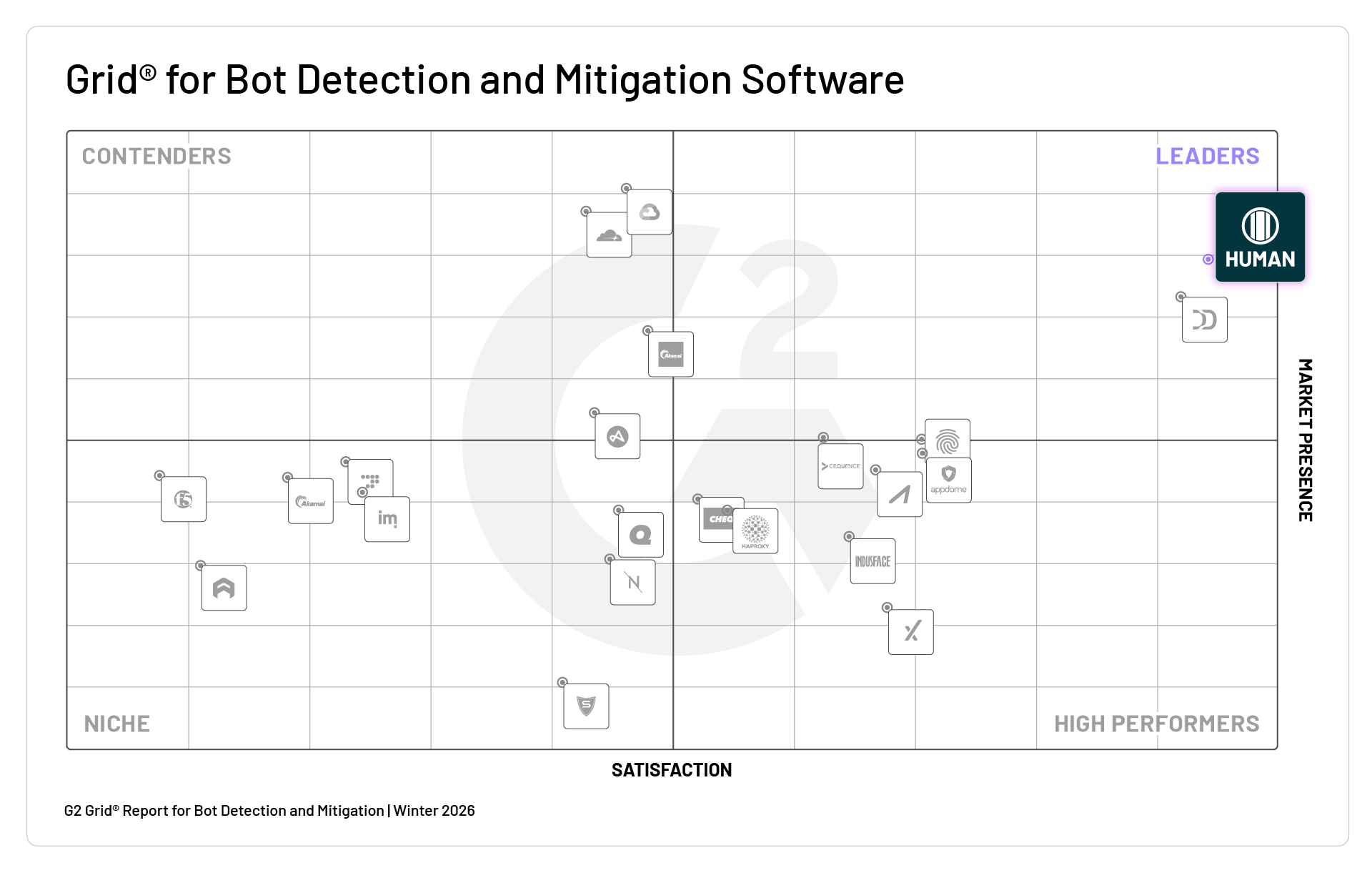
G2 Bot Mitigation and Detection Leader
Customers rank HUMAN #1 in G2’s Bot Detection and Mitigation category
Learn More
Hear from HUMAN Customers
Read our case studies on HUMAN customers and how they are reducing cost and risk and ensuring operational efficiency and business innovation with HUMAN.
Learn more










HUMAN Is Your Differentiator
Make a trusted customer experience your competitive advantage