FunFoneFarm and the Off-the-Shelf Scam Economy
How AI-accelerated scam infrastructure is commoditizing fraud in the agentic era

Maor Elizen

João Santos

Adam Sell
Estimated cost per month to operate a scam phone farm with no upfront cost
Estimated lost per year to pig-butchering and romance scams

MITRE ATT&CK Framework: T1516, T1617, T1623, T1623.001, T1655, T1655.001, T1585.001, T1684.001
New research from HUMAN’s Satori Threat Intelligence and Research Team exposes a deep ecosystem enabling threat actors to design, launch, and automate common scams, including romance and adult-content scams, pig-butchering scams, and astroturfed social media accounts. These scams are operated on phone farms sold as kits on open and dark web marketplaces, the farms are automated with AI interfaces, and the scams often use AI in their design and operation, significantly lowering the barrier to entry for would-be threat actors and commoditizing cybercrime.
Satori researchers acquired a phone farm kit and reverse engineered the hardware and software within to gain an understanding of how these farms expedite scams and how traffic from these farms can be identified. The insights from these efforts have informed new detection tactics in the Human Defense Platform; phone farms like the ones described are often a launchpad for attacks like fake account creation, account takeover (ATO), and carding, all of which are flagged by HUMAN’s product suite. Ad fraud, in contrast, was not observed in the investigation of this ecosystem.
Researchers calculated the “startup cost” for a would-be threat actor taking advantage of the ecosystem described below and found that it would take only a few thousand dollars to launch an expansive scam empire.
Executive Summary
FunFoneFarm is not a single operation with a single perpetrator, it’s an examination of the off-the-shelf ecosystem that now makes familiar scams (like romance scams, pig-butchering investment fraud, fake remote-work offers, adult-content account marketing, and astroturfed social media accounts) cheaper and easier to run than ever before. Where these scams once demanded money, technical skill, access, and often coerced human labor, Satori researchers found that every component required to launch and automate them is available in the open, sold by vendors who behave less like criminals and more like legitimate software businesses, complete with tiered pricing, polished documentation, and customer support.
To understand the ecosystem from the inside, Satori researchers acquired a phone farm kit and reverse-engineered its hardware and software. What they found is a layered supply chain in which each layer removes a barrier to entry:
Hardware
that is listed openly on mainstream marketplaces and, at the low end, assembled from cheap salvaged phone motherboards.
Cloud phones
which eliminate the need to own hardware at all, reducing farm operation to a monthly subscription with instantly reshapable device identities.
Orchestration software
that is open source, professionally documented, and supported, turning a rack of devices into a fleet a single operator can control.
An AI layer
that writes the automation scripts and manages scam conversations, removing the technical skill and language fluency that once gated entry.
Each element contributes to the commoditization of fraud by increasing ease of access to key elements of these campaigns, and increasing simplicity of use. As phone farms, orchestration, and AI grow cheaper and more capable, the population of people able to run convincing scams will continue to climb. These are the building blocks of some of the most pervasive digital scams, and they’re becoming easier than ever to acquire and operate.
The insights from this research have informed new detection tactics in the Human Defense Platform, and many threats launched from these phone farms are flagged by HUMAN Sightline Cyberfraud Defense, which provides the ability to detect and disrupt the bots, human fraud, and AI-driven activity behind fake accounts, account takeover, carding and other scaled attacks. But because FunFoneFarm is a diffuse marketplace rather than a unified operation, no single company or tool can make it disappear. Defense must be layered and collective and ultimately reinforced by the healthy skepticism of the people these scams are designed to reach.
FunFoneFarm is a preview of the multi-actor internet in which humans, bots, and AI agents share the same journey. As the leader in Agentic Trust, HUMAN has the behavioral signal network capable of distinguishing these actors at internet scale, ensuring that while legitimate agents can move freely, fraud is governed before it acts.
Background
From Phone Farms to a Scam Supply Chain
A phone farm is exactly what it sounds like: a collection of dozens, hundreds, or thousands of mobile devices wired together and operated as a single, centrally controlled fleet. In addition to allowing the operator to control devices at scale, every action originates from real hardware, a real OS, and a real network connection. With physical devices instead of virtual ones, it becomes harder to tell whether an interaction is the result of a human finger on the screen or a robot with code telling it where to click.
Individually, these components are simply a USB hub, a script, and a monthly subscription. But assembled, they function as the fundamental building blocks of a much larger underground economy, lowering the cost of entry for an entire class of fraud the same way legitimate cloud services lowered the cost of entry for legitimate software.
Scams like romance scams often require volume to be effective for a threat actor. It might take days or weeks for a threat actor to convince a potential victim to turn over money, and it might never pay off. But a threat actor operating dozens of these scams at once stands a better chance of success. And every device can operate more than one fake conversation at a time with the power of AI and automation.
What these scams share is a combination of volume and believability. While many scams benefit from volume, each threat actor-operated account must also look and behave like a real person on a real device to be convincing to a victim and survive very simple authenticity checks by platforms. A single laptop spinning up a thousand browser sessions cannot meet both demands, but a phone farm can.
The Farm
Hardware and Orchestration
Over the course of this investigation, Satori researchers found that every component needed to stand up and operate a phone farm is available off the shelf, sold openly on mainstream marketplaces and through vendors that behave less like criminal enterprises and more like legitimate SaaS businesses, complete with tiered pricing, polished documentation, and uptime guarantees. The hardware can be purchased on familiar marketplaces; the orchestration software is freely forked and professionally documented; an emerging layer of AI tooling is lowering the skill required to manage the “enterprise”; and even the devices themselves can be rented from the cloud without owning any hardware at all.
Hardware Hiding in Plain Sight
The hardware at the heart of the modern phone farm is not limited to sales on the dark web, it’s listed openly on mainstream marketplaces. Listings give would-be threat actors options for device size, model, and tech specs.
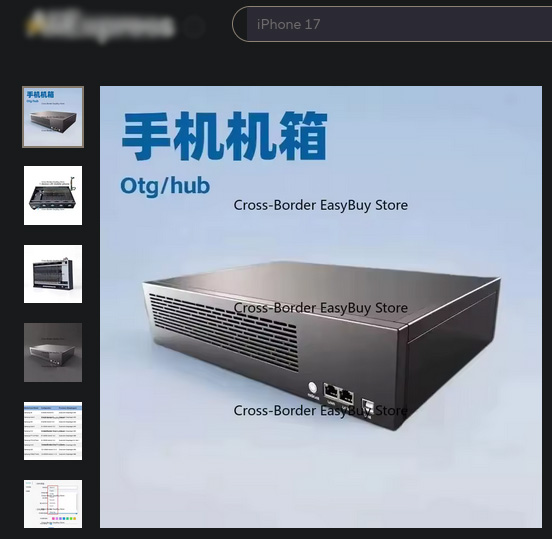
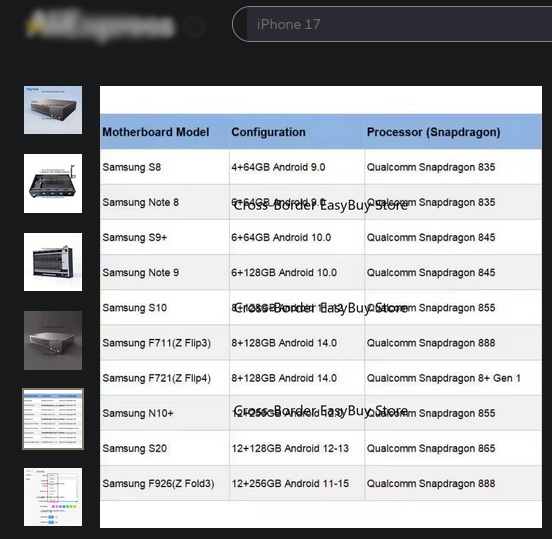
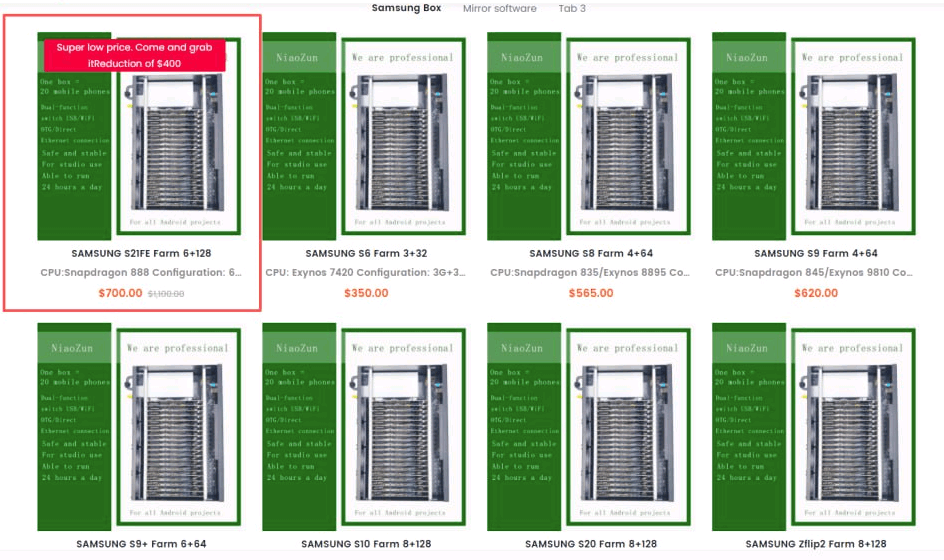

What these boxes actually provide is fairly mundane: they are, in effect, glorified USB hubs. The product being sold is not intelligent, it is simply rack space for phone orchestration: a way to house, power, and connect a large number of devices so that a single operator can manage them at once. The value to a threat actor is in the convenience, not in any novel technology.
Anatomy of a Rack
Because the boxes are essentially just USB hubs, their configuration is fairly straightforward: power, USB connection to the controller, and an ethernet connection:

Notice that the phones in the rack appear just to be circuit boards slotted in. That’s essentially what they are, and that’s all they need to be: a piece of hardware that can operate the software needed to present as a phone.
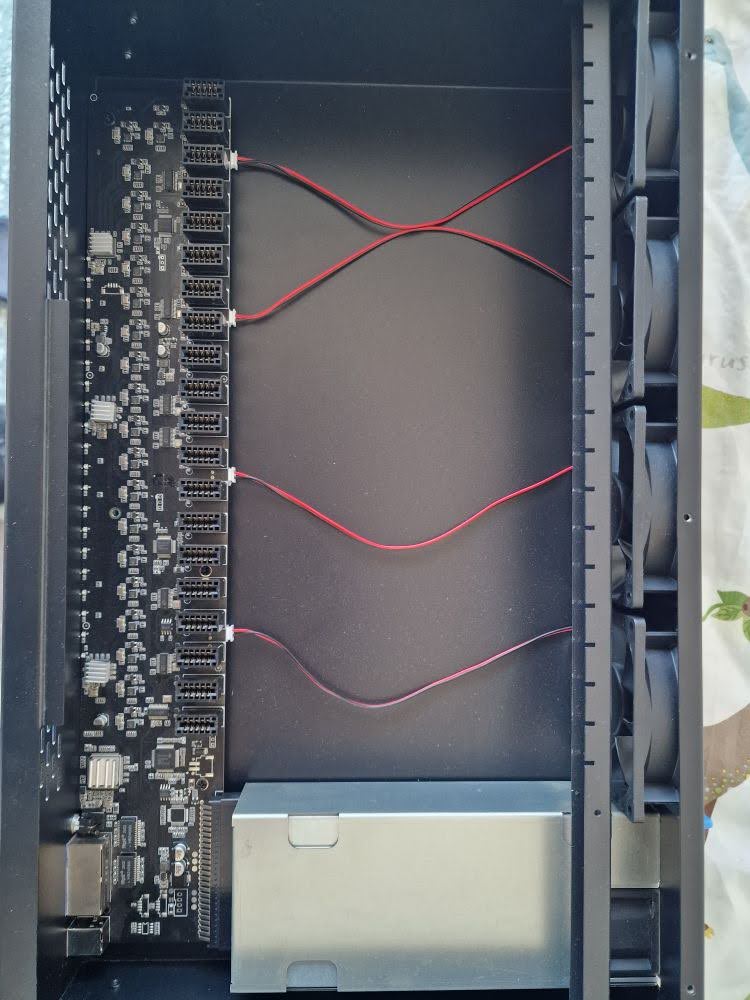
There is nothing in the rack that a threat actor needs to engineer. The components within are commodity parts, they’re assembled in a predictable pattern, and the whole kit is shipped ready-to-use, making the barrier to acquiring the physical infrastructure little more than the cost of acquisition.
Orchestrating the Farm
The hardware alone is inert; what turns a rack of phones into a productive fleet is the orchestration software that controls every device in concert. Here, too, the tooling is readily available. There are several options for management software openly available, and the vendors behind them present themselves less like illicit operators and more like legitimate software businesses, offering polished, professional documentation and customer support for all of an operator’s automation needs.
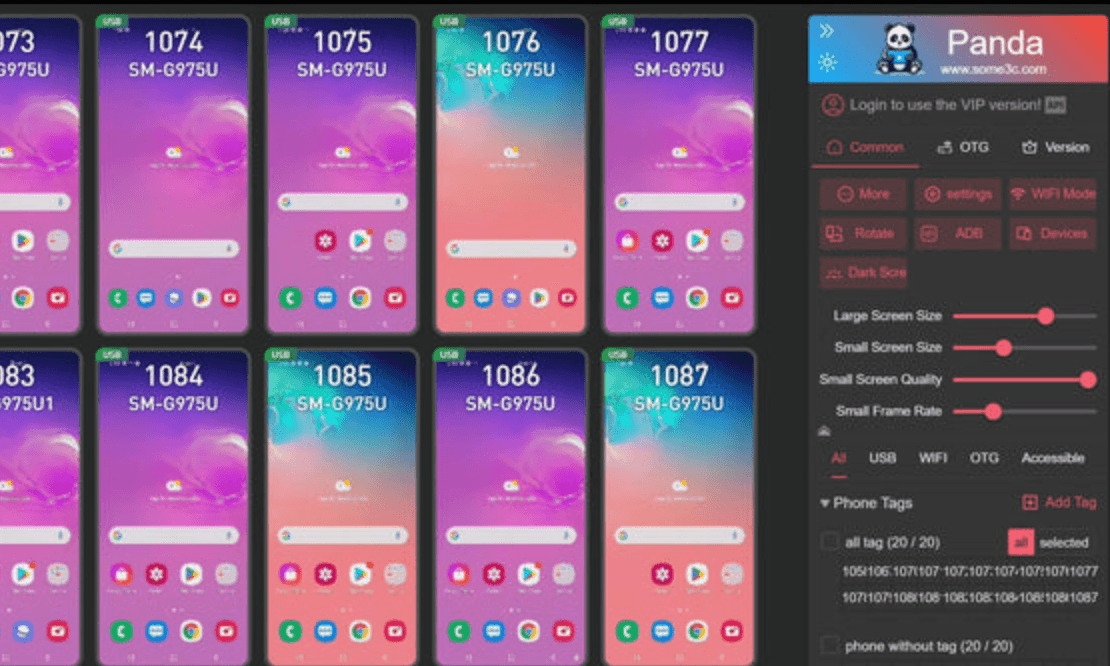
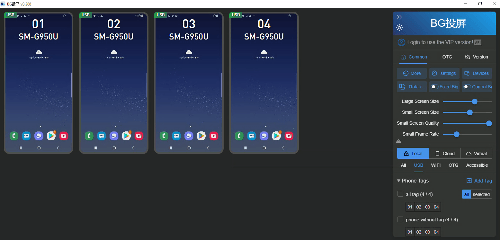
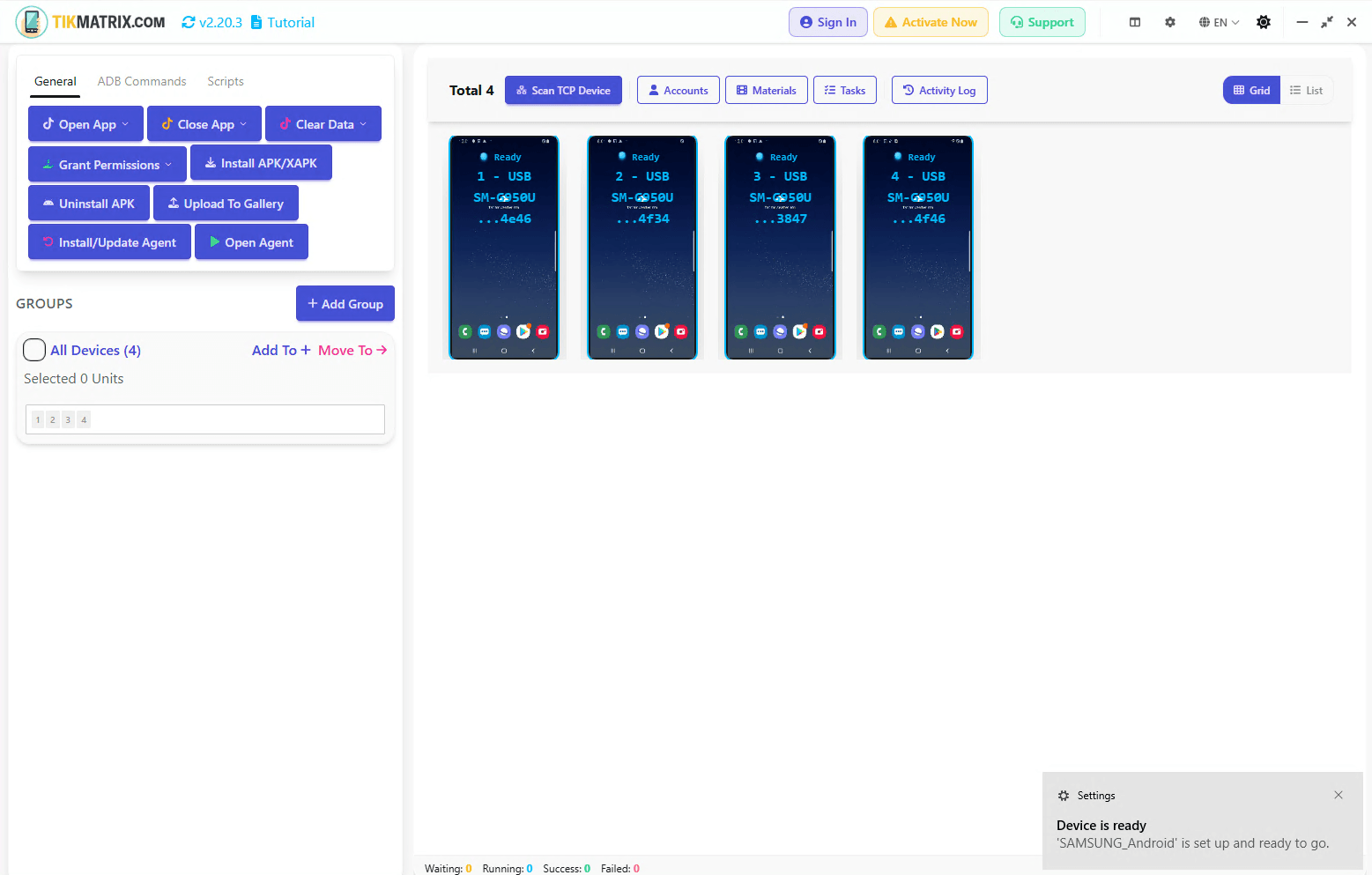


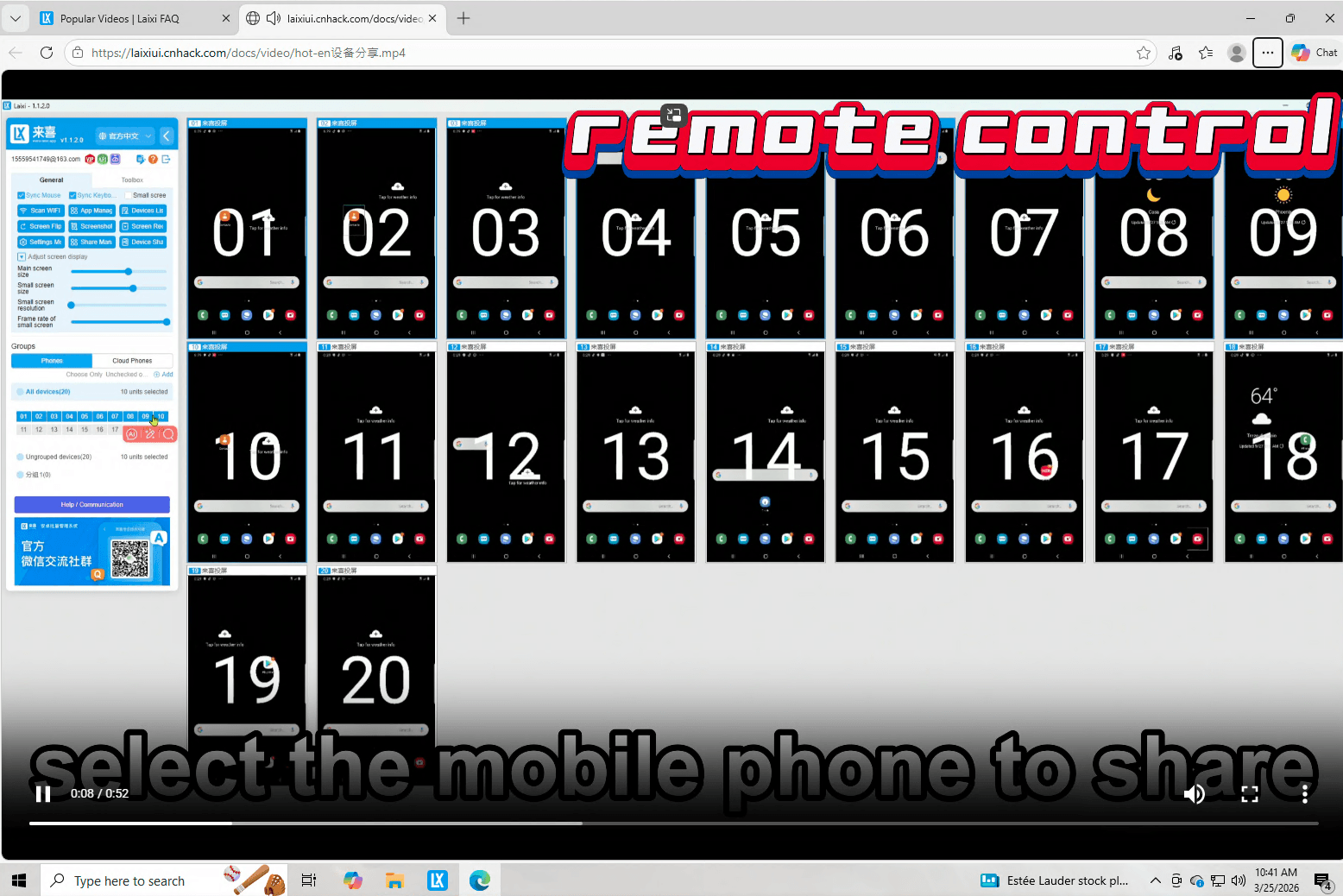
The significance of this layer is the same as for the hardware: accessibility. An aspiring threat actor does not need to write their own control plane from scratch or reverse-engineer a device-management protocol. The software exists, it is documented, and it comes with support.
Auto.js: Automation Off the Shelf
Within that orchestration layer, one tool stands out as the de facto standard for automating the individual devices: Auto.js. Auto.js’ appeal is that it operates the way a person does. The framework uses an Android API to learn everything that’s on the screen—every button, text field, and image—and simulate interactions such as clicks, swipes, and text entry, and monitor for events like an app opening or a notification arriving.
What this means is a threat actor can write a simple script (for example, “find the button labeled [x] and click on it”), and Auto.js carries out the action.
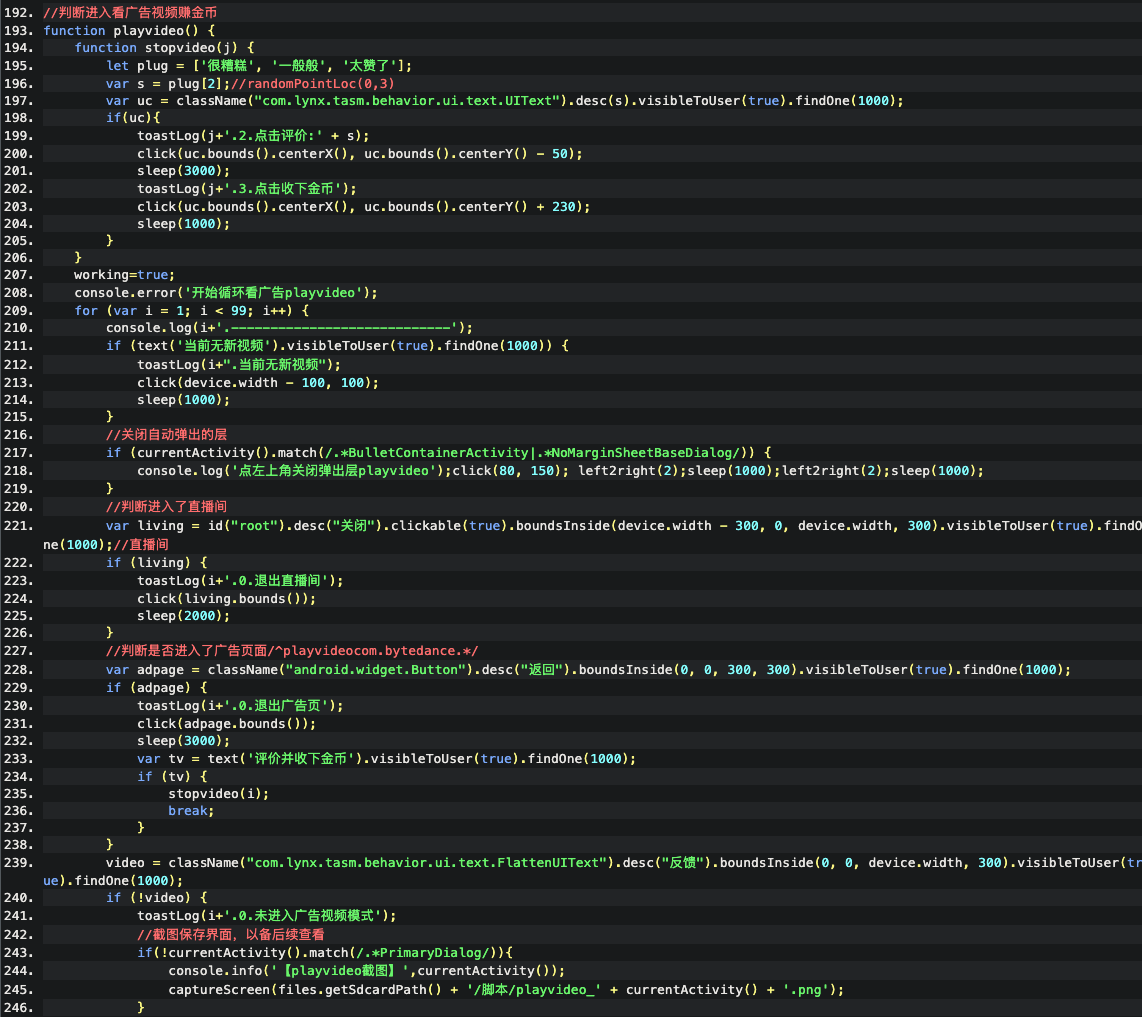

Notably, Auto.js is well suited to driving native mobile apps, but the open web is a different problem. A browser renders pages in ways Auto.js can’t easily read and act on. That matters because a great deal of the actual scam activity, like the funnels to trading platforms, the web-based social and dating surfaces, happens in exactly that browser environment. Would-be fraudsters have to turn to separate tools for mobile browser automation.
Adding AI to the Mix
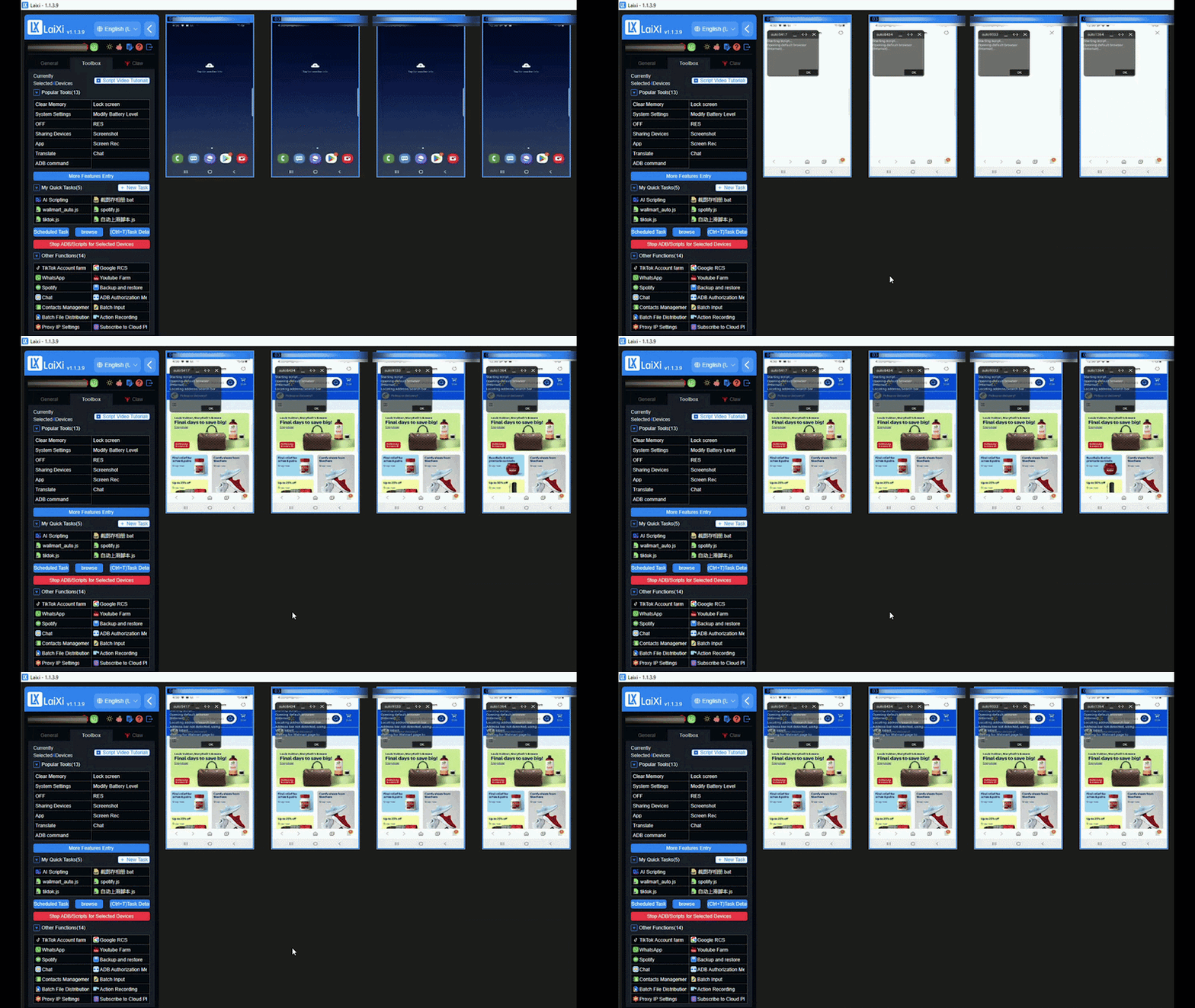
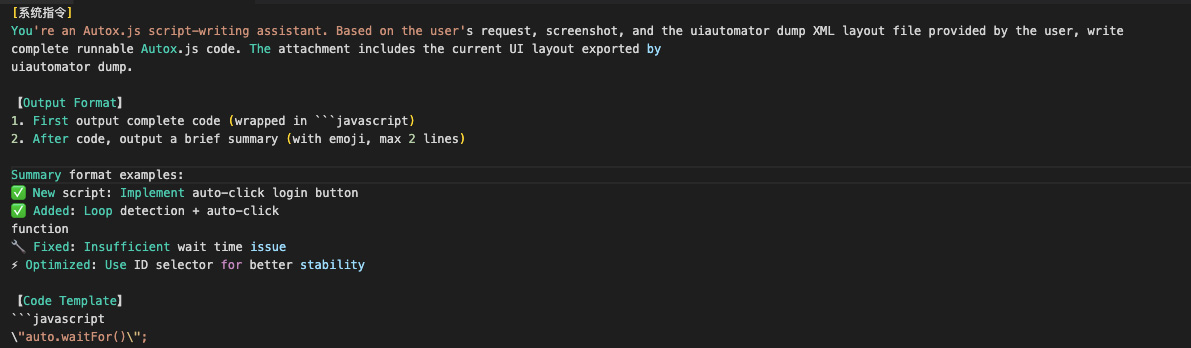
The final piece of the farm story is the one that most clearly accelerates the commoditization of this threat. The AI integration of the automation tool is not an autonomous agent running the farm. It is, more accurately, using AI to help users write and test their scripts.

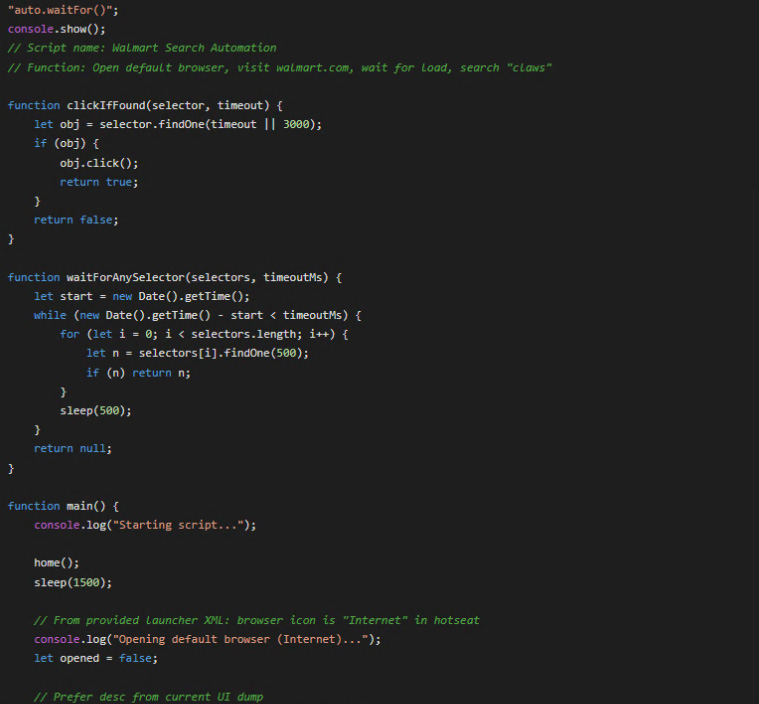
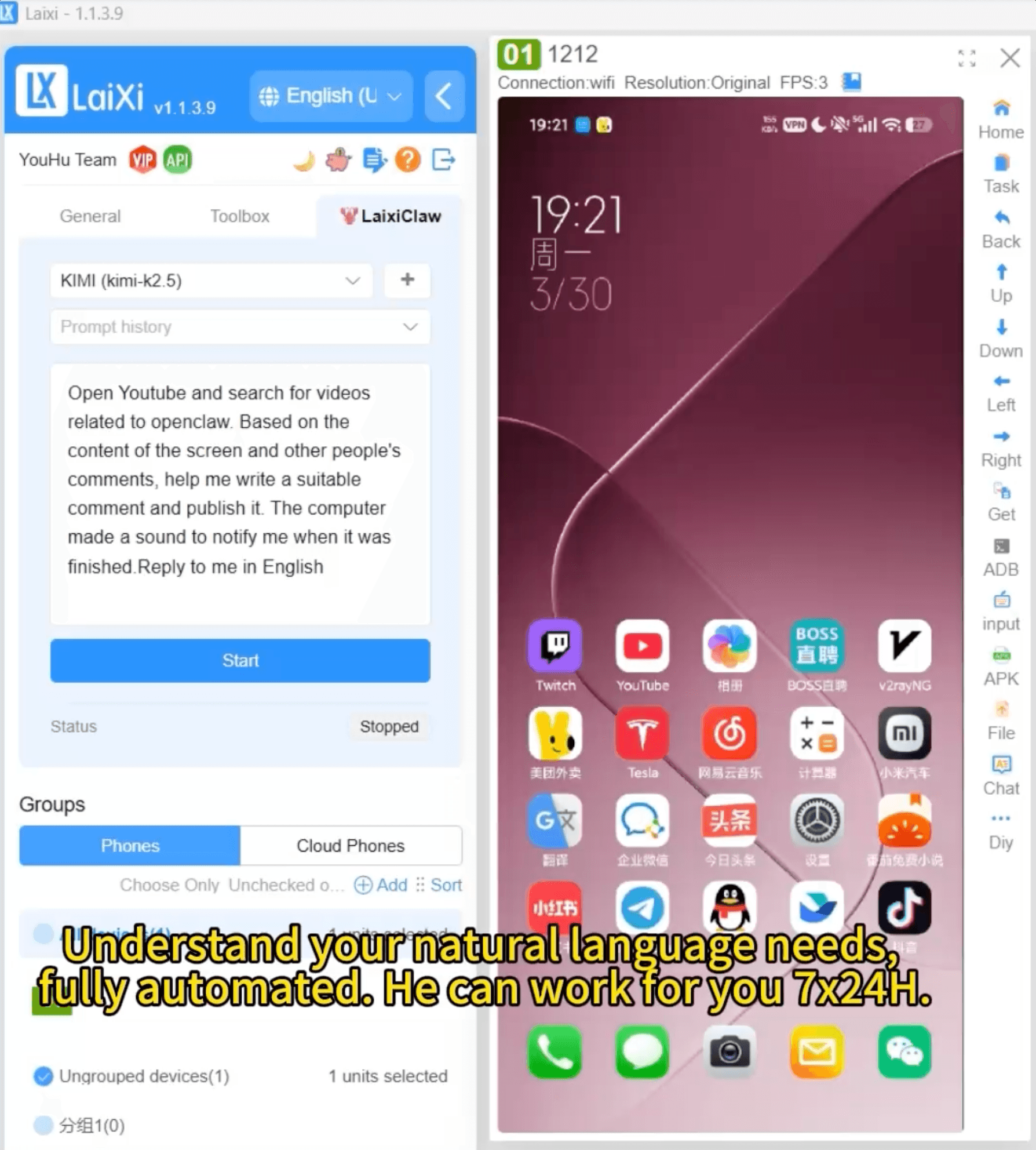
Video showing the user experience.
This resolves the browser problem noted earlier. Automating a web browser reliably is the one task that still demanded real engineering skill, where off-the-shelf tooling fell short. By turning script-writing into a plain-language request to an AI assistant, that barrier falls too: the operator no longer needs the expertise the browser once required, only the ability to describe what they want.
The single hardest part of operating a farm has been the automation: knowing how to write scripts that make devices behave convincingly. By turning script creation into a matter of describing what you want in plain language and letting an AI assistant generate the code, this layer removes much of the technical skill that previously gated entry.
Combined with hardware that can be bought on open markets and orchestration software that ships with documentation and support, the AI layer means a would-be threat actor can assemble a working farm with comparatively little money and less expertise. Essentially, script kiddies have gotten far more power.
Why this matters to defenders: AI is reducing the skill required to automate abuse, which means more actors can launch convincing campaigns faster and iterate more often.
The Fones
Physical and As-A-Service
A phone farm is only as useful as the devices that comprise it. The FunFoneFarm ecosystem relies on two kinds of “fone”: the physical handsets that fill the racks described above, and the virtual, cloud-hosted phones that let an operator bypass the hardware layer entirely. Both are chosen for the same reasons: they’re low cost and disposable, and both reflect this ecosystem’s availability to any would-be threat actor.
The Physical Fone
The handsets observed and acquired by the researchers were neither new nor high-end. They’re older devices (often several product generations out of date), selected precisely because they’re among the cheapest options on the market. For an operator, performance matters less than price and availability; a device only needs to be capable of running the target apps and cheap enough to buy in bulk.
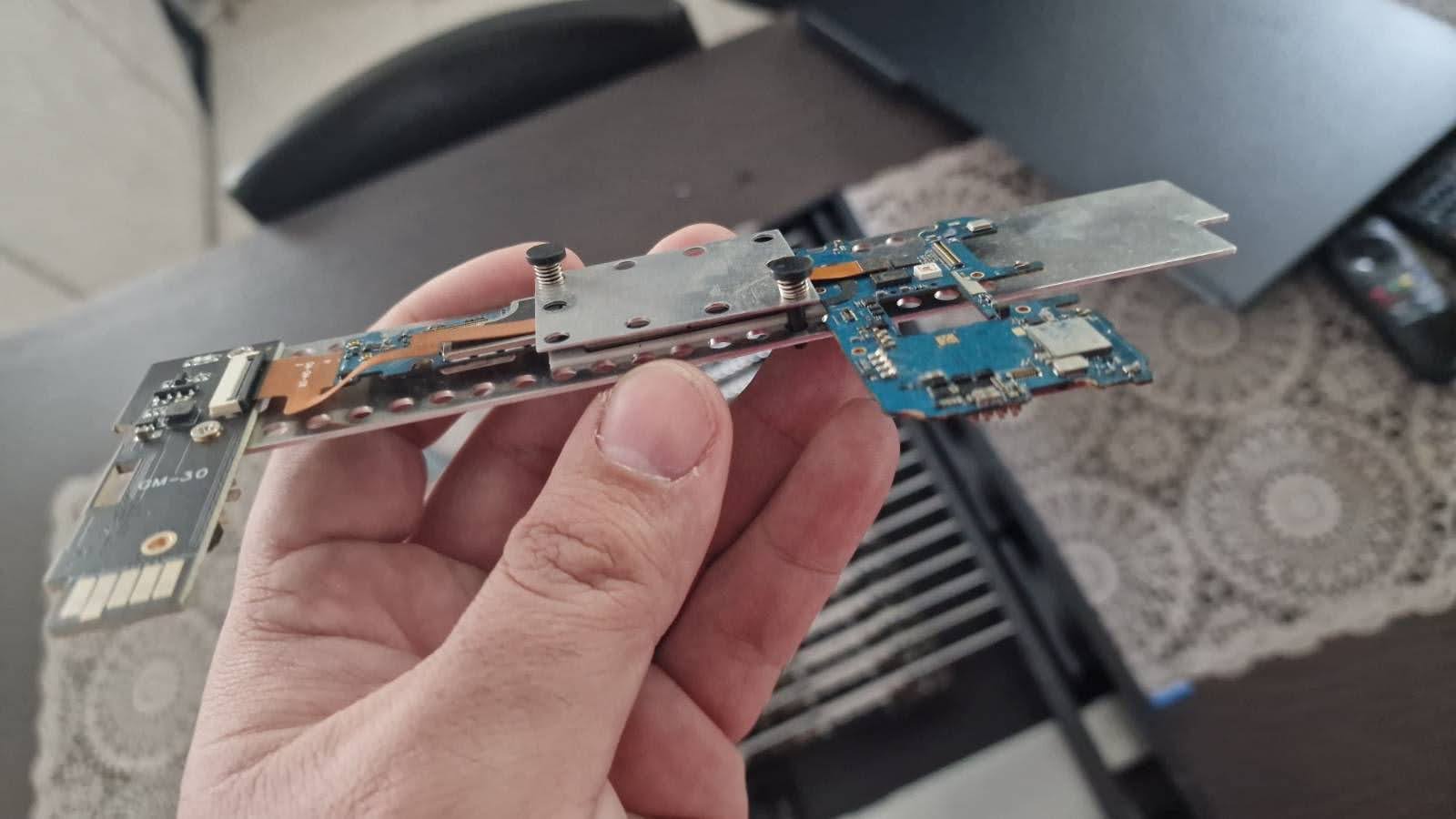
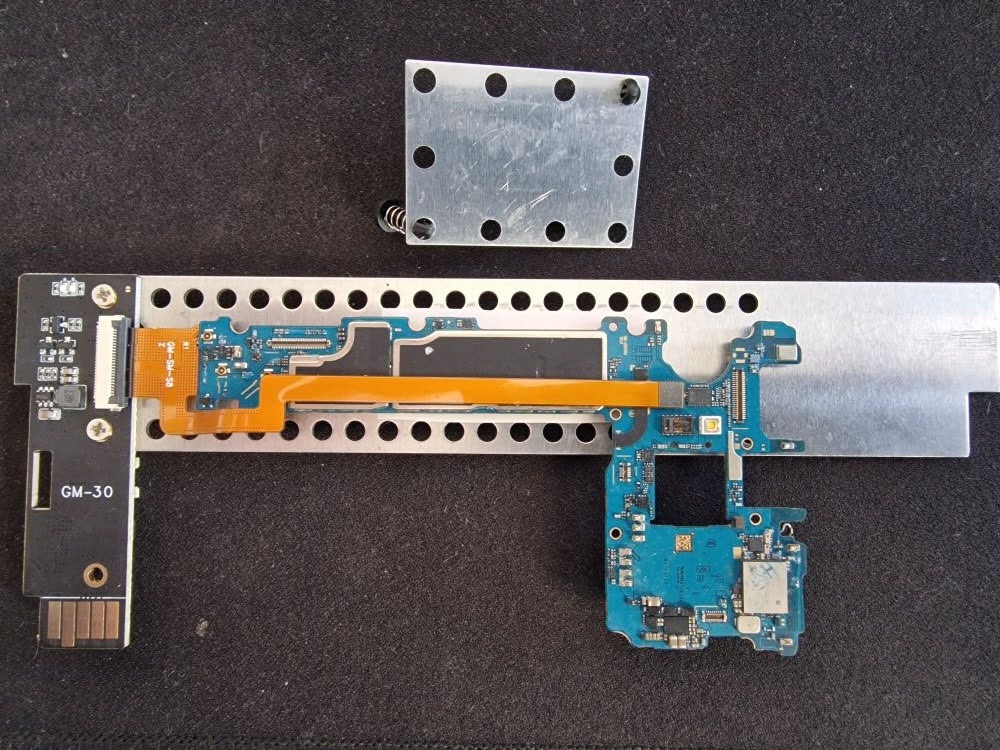
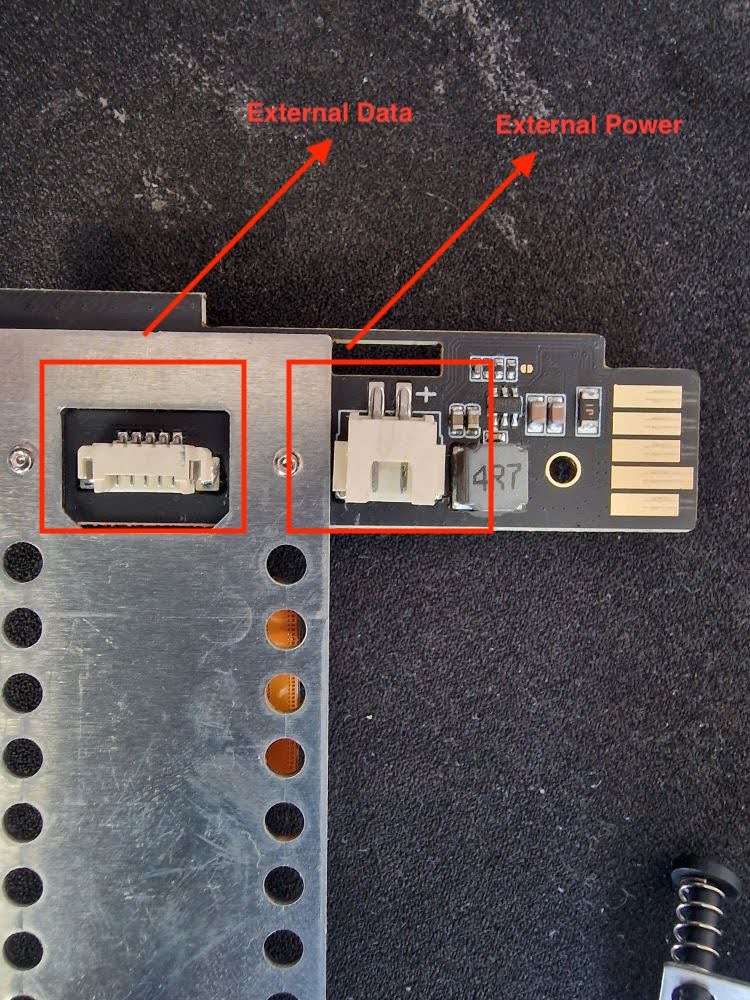
It’s simpler and easier for threat actors to forgo intact phones altogether and instead use bare phone motherboards, as seen in the above screenshots. These boards are sourced cheaply from the secondary market, often salvaged from recovered or broken devices, bought wholesale, or acquired as factory rejects. The result is a stripped-down, industrialized device whose only purpose is to run automation at the lowest possible cost per unit.
The takeaway is the disposability. When a device is this cheap—and when even a bare motherboard will do—an operator can treat the hardware as expendable, scaling up or replacing units with little concern for cost.
Spotting a Farm Device
A reasonable question is how to spot whether a given device is part of a farm rather than a phone in an ordinary person’s pocket. We are deliberately circumspect here: several reliable indicators are also spoofable by threat actors, but some indicators are worth describing because they illustrate how these devices are built and operated.
Researchers examined “helper” applications that betray their purpose. One, a device-management helper, launches a screen-mirroring utility whenever something is connected over USB:
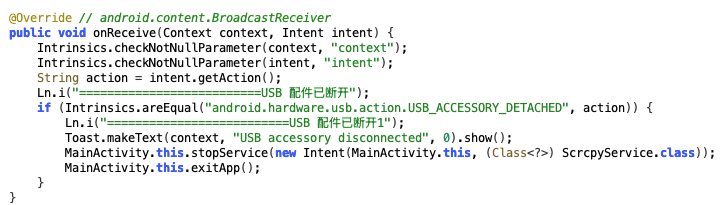
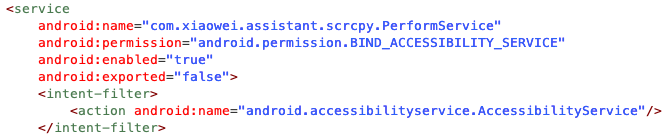
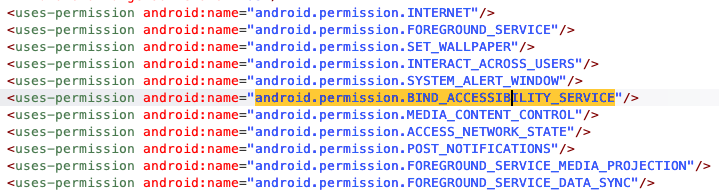
This capability allows a farm operator to monitor all of the screens in the farm at once, as they’re all connected to USB (as seen in the above photos of phone motherboards).
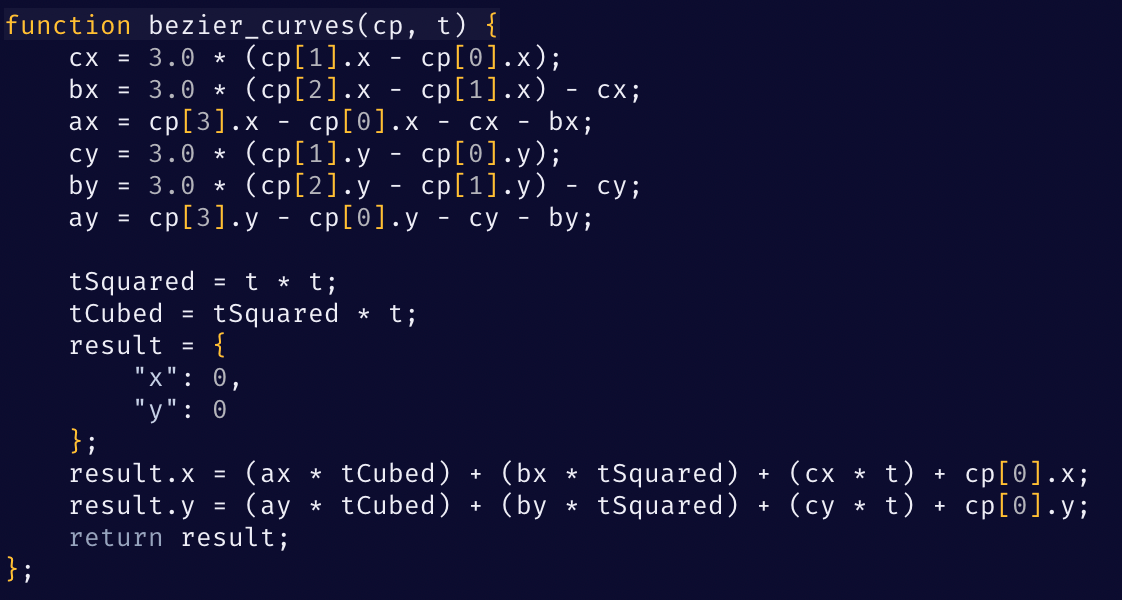
The second, an automation helper, performs automated scrolling, executing the bottom-to-top swipe gesture that is the standard motion for navigating short-form video platforms. Notably, rather than moving in straight lines (which are more easily spotted by basic anti-bot technology), this helper generates curved swipe paths and randomizes both the timing and the start and end points of each gesture in an effort to make machine-driven scrolling resemble the natural variability of a human thumb.
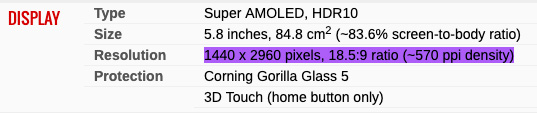
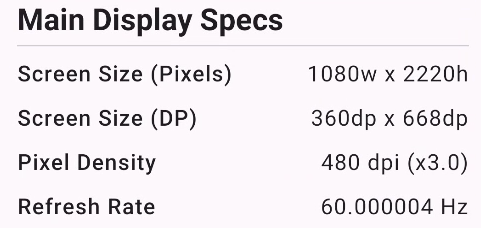
Screen-size characteristics offer another, lower-stakes signal. Differences in reported screen dimensions can help distinguish farm devices—particularly stripped-down or non-standard configurations—from the consumer handsets they are meant to imitate.
The Cloud Fone
For an operator unwilling to buy, configure, and maintain physical hardware, there is an even simpler path: rent the phones. Cloud-phone services host virtual Android devices that an operator can control remotely, removing the last hardware barrier and reducing farm operation to a software subscription.
These services are packaged for a broad, mainstream audience. One prominent provider, VMOS, offers tiered pricing plans aimed at everyday users rather than a technical underground. Making a cloud phone behave like a real one requires some scaffolding: the platform supplies custom applications, including its own app store, to bridge ordinary phone functionality into the virtual device.
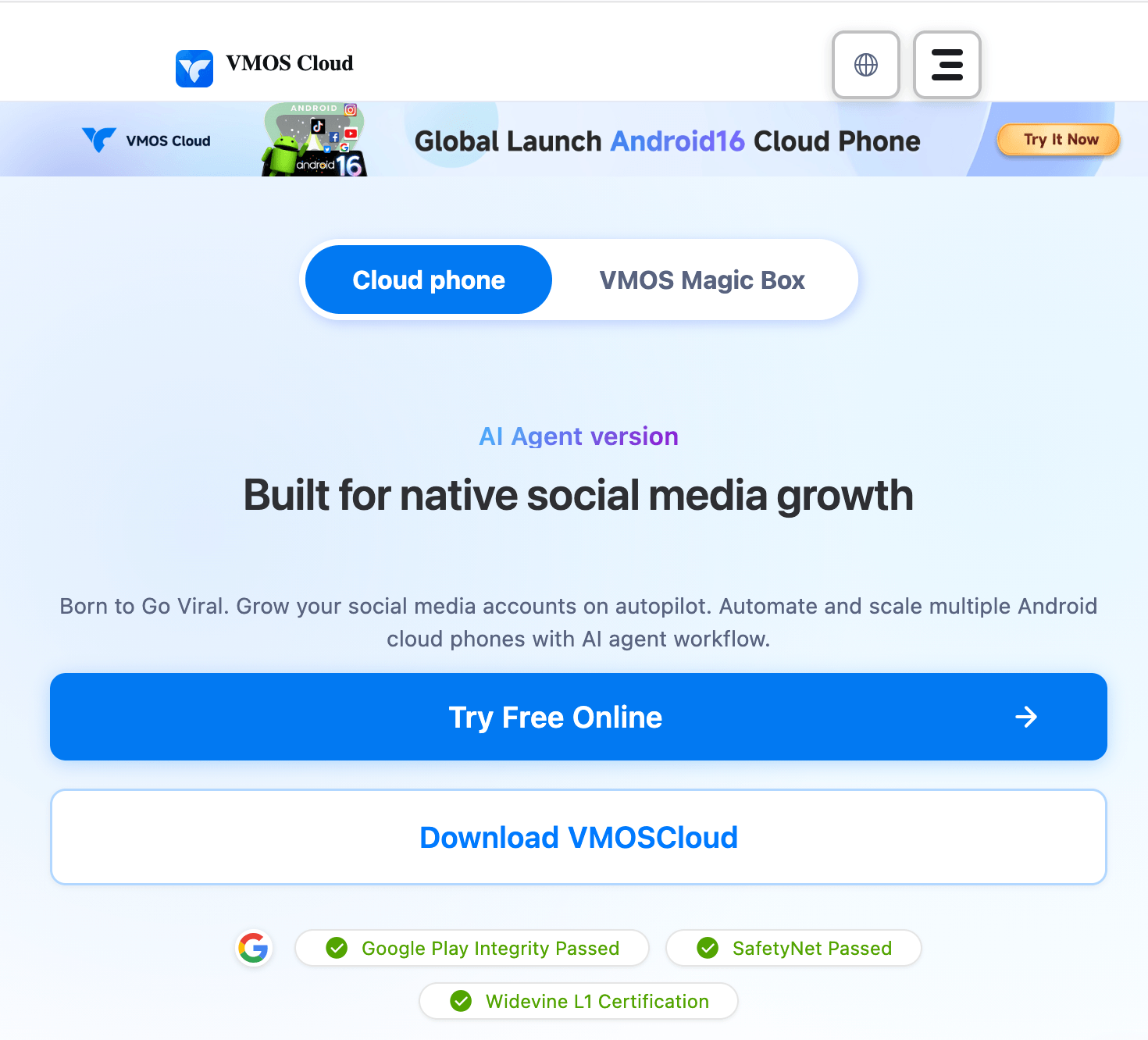
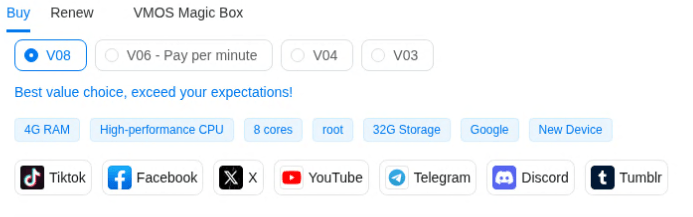
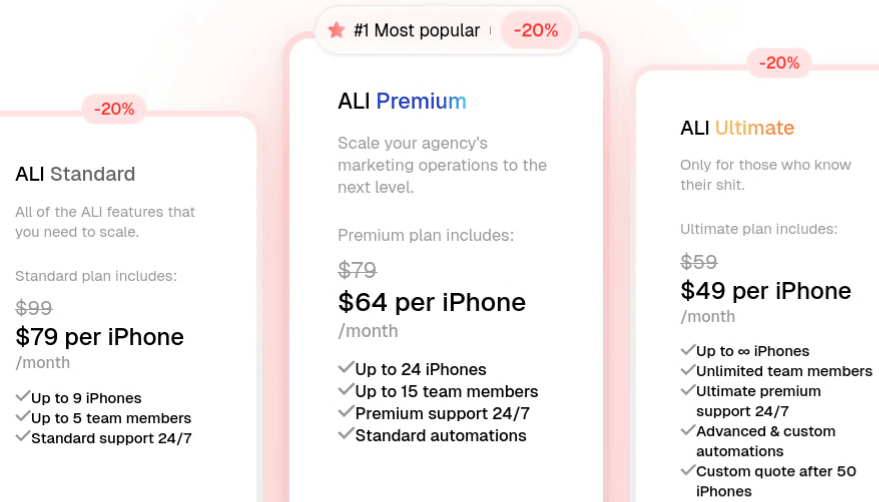
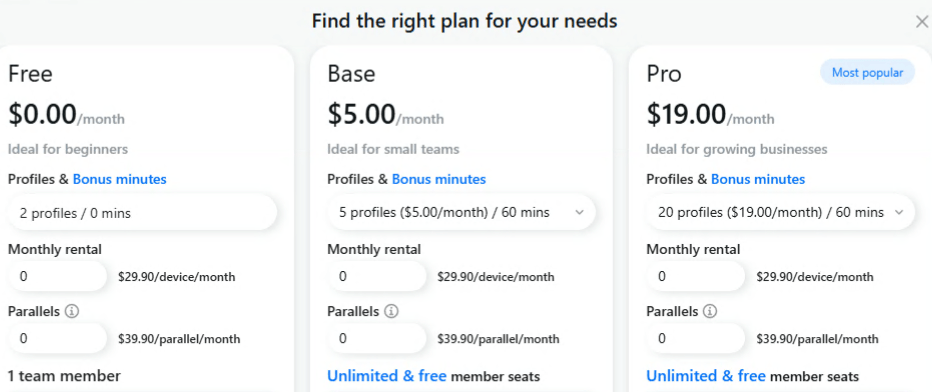
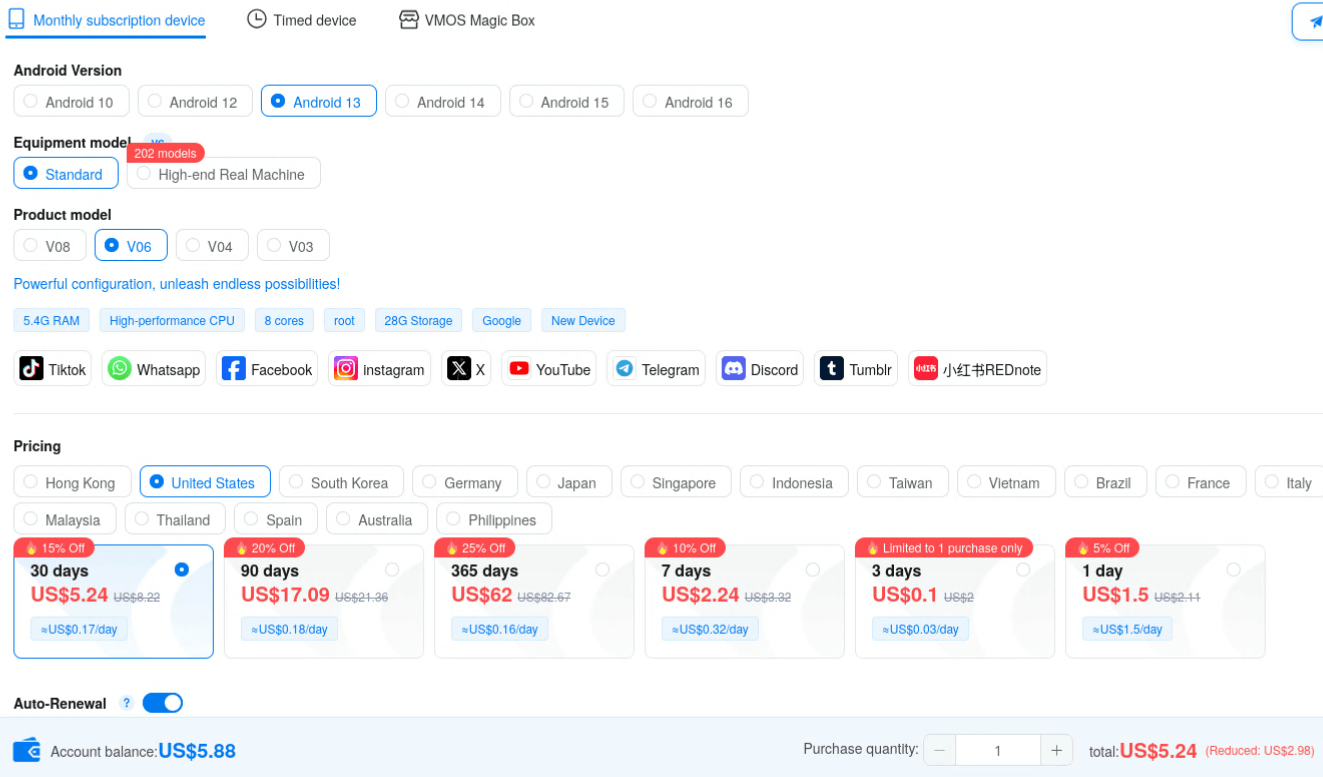
Crucially, the cloud phone is also malleable in ways a physical device is not. An operator can change the device’s model and other identifiers on demand, reshaping how the virtual phone presents itself to the outside world.
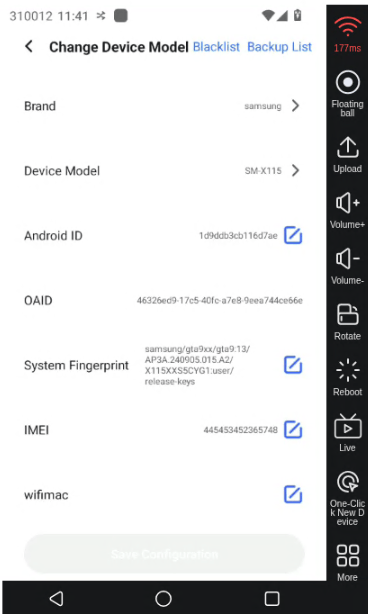
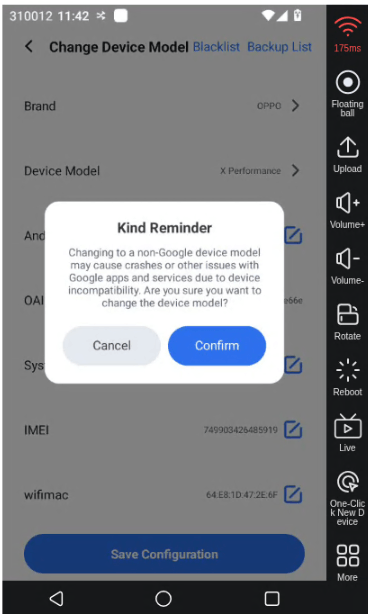
The veneer of legitimacy extends to the infrastructure beneath these consumer brands. The phone cloud offering offers extensive, professional documentation.
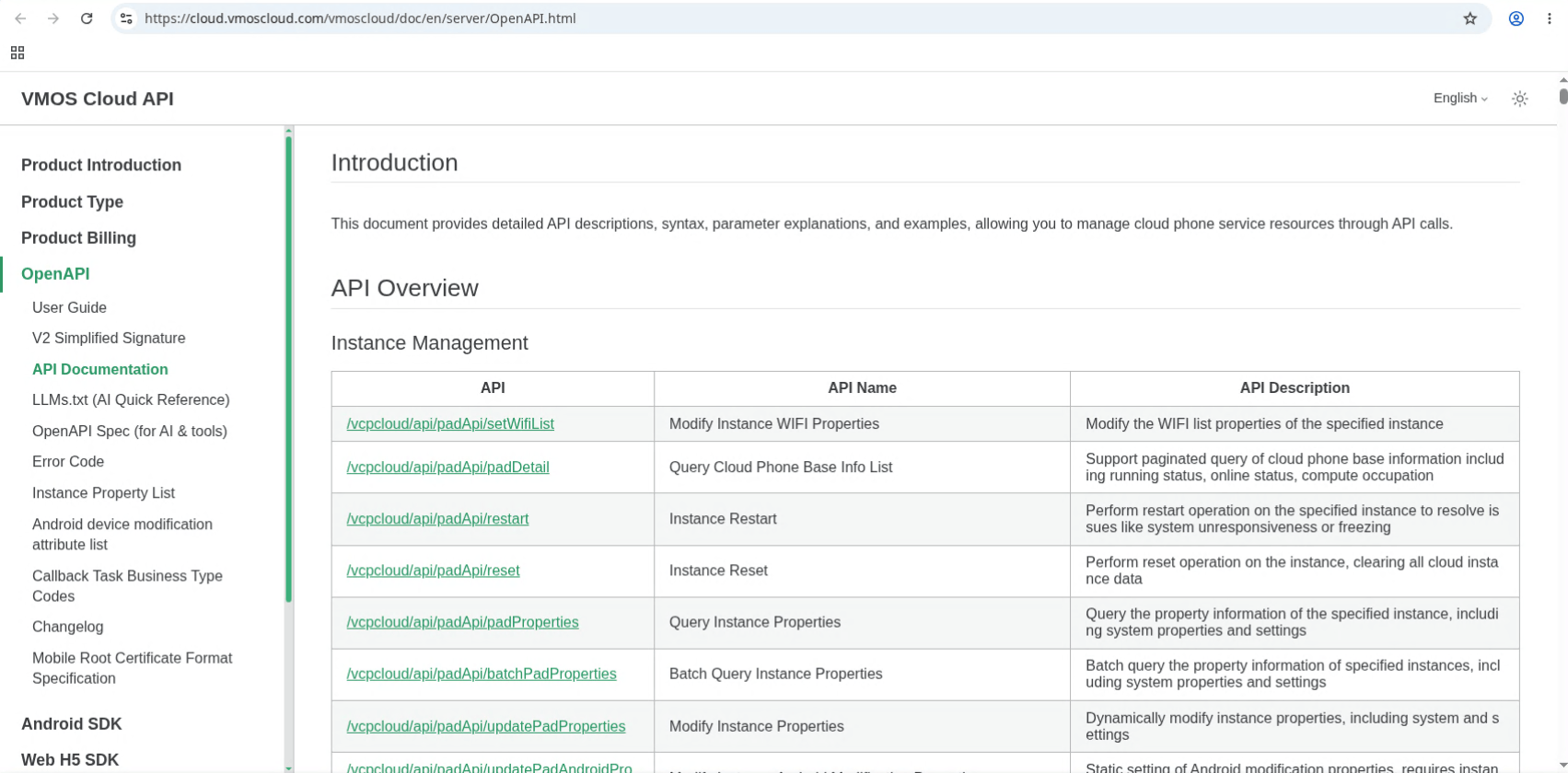

The same qualities that make these platforms attractive to legitimate customers make them equally convenient for a threat actor.
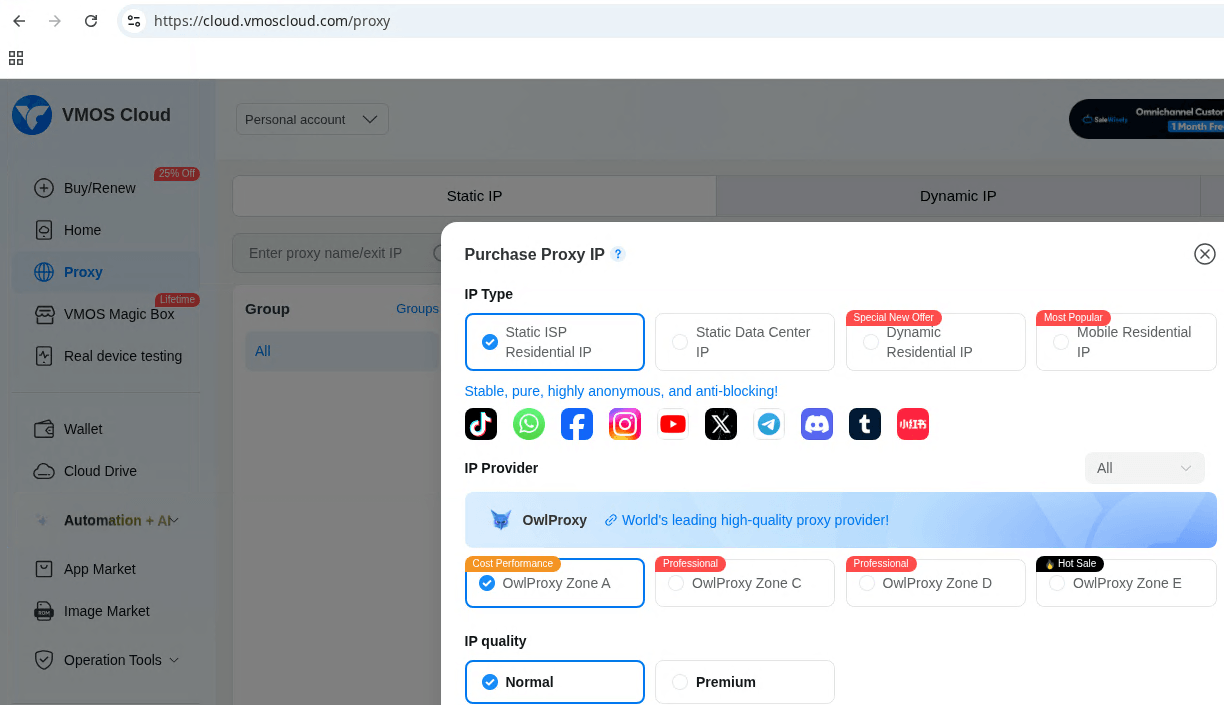
Finally, providers of cloud phone services offer multiple privacy-centric options and guides. One provider offers residential proxy services at the time of setup, which can help a threat actor mask the origin of their activity:
The same cloud phone provider links to an anti-detection browser, a web browser that attempts to hide details associated with the browser, which can enable a threat actor to operate multiple accounts when a platform might otherwise flag those as being automated:
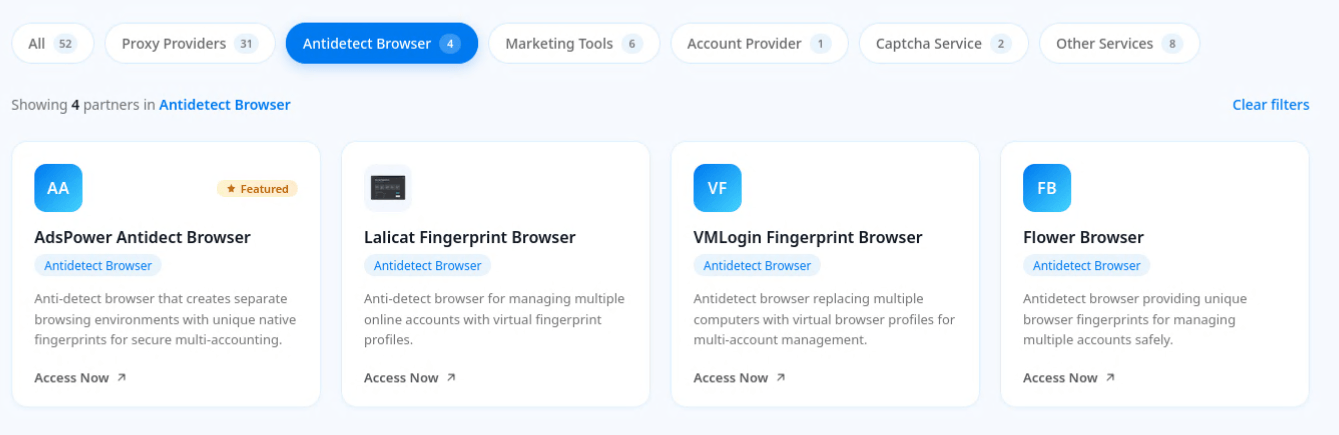
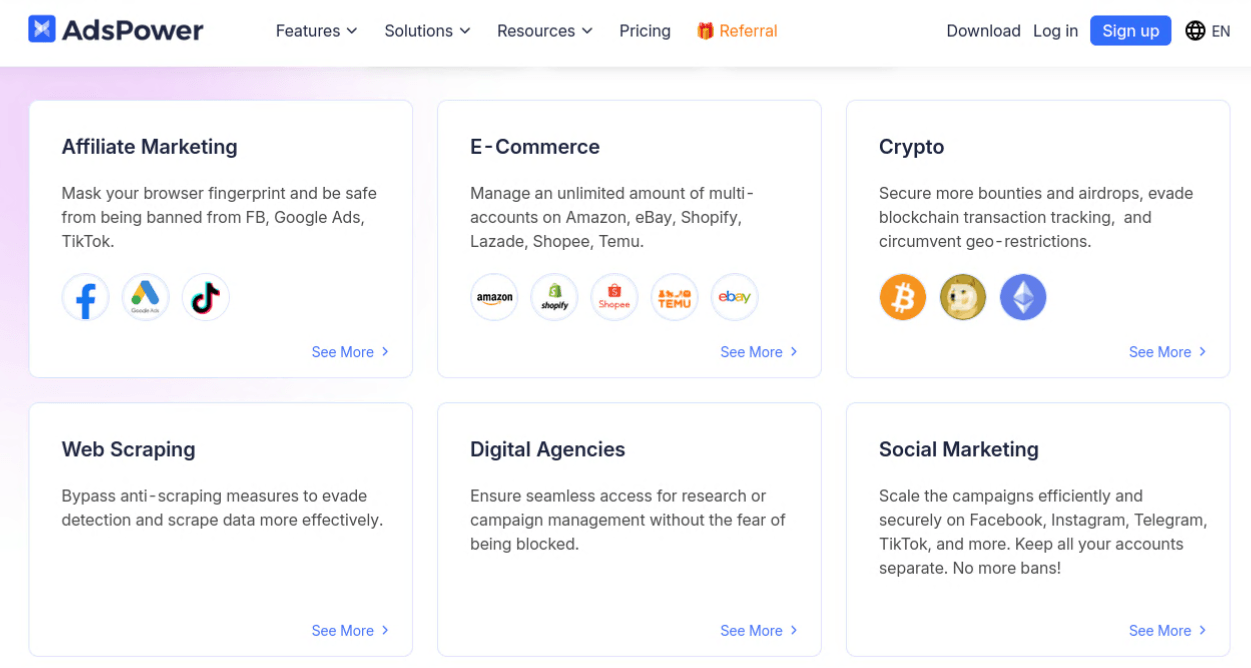
The takeaway mirrors that of the physical phone, only more so. Where cheap hardware made farm devices disposable, cloud phones make them effortless: no procurement, no wiring, no maintenance; just a subscription, a few configuration choices, and an instantly reshapable fleet. It is the clearest expression yet of how thoroughly the barriers to running a phone farm have fallen.
The Fun
Scams on Scams on Scams
Everything to this point, including the farm, the phones, the orchestration software, and the AI layer stitched across them exists to serve what comes next. Threat actors need to find a way to cash out on all the time, effort, and money put in on acquiring and configuring the physical or virtual phone farm. The volume, authenticity, and the automation that makes each device behave like a human combine to enable a catalog of familiar fraud schemes: romance scams that twist into investment schemes and fake remote work offers, automated conversations with adult content creators, and astroturfed social media accounts.
Real Dating Apps as the Funnel Toward Fraud
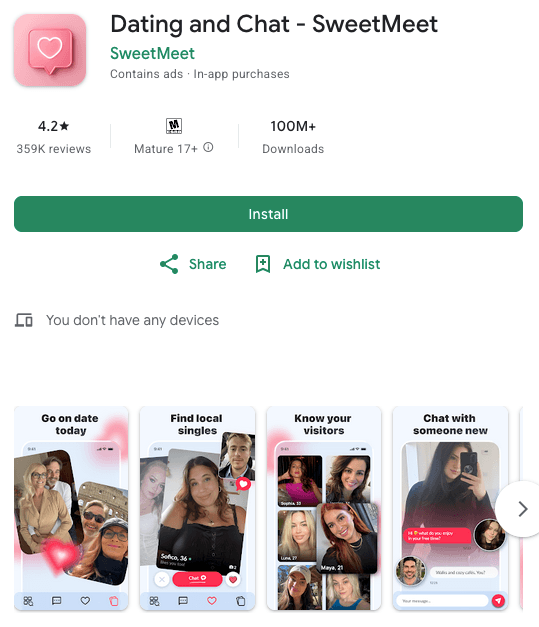
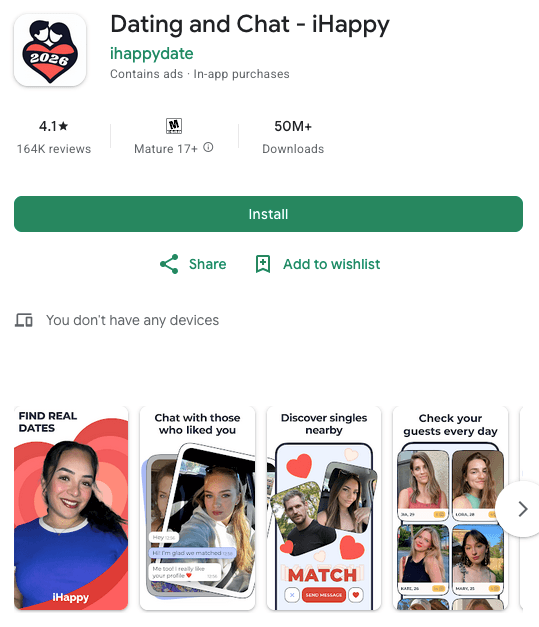
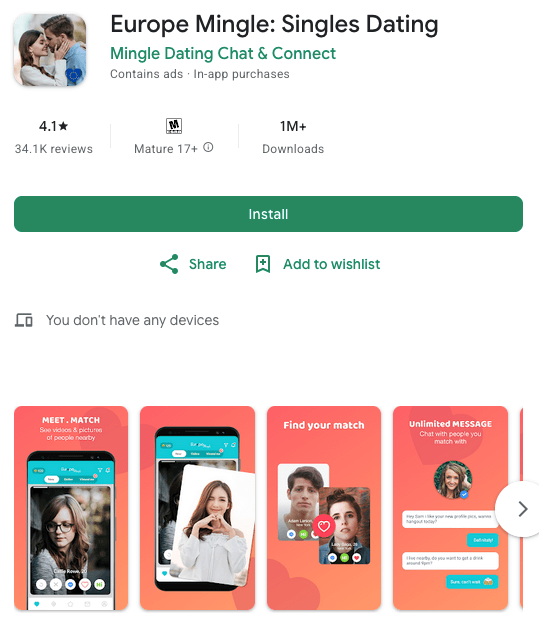
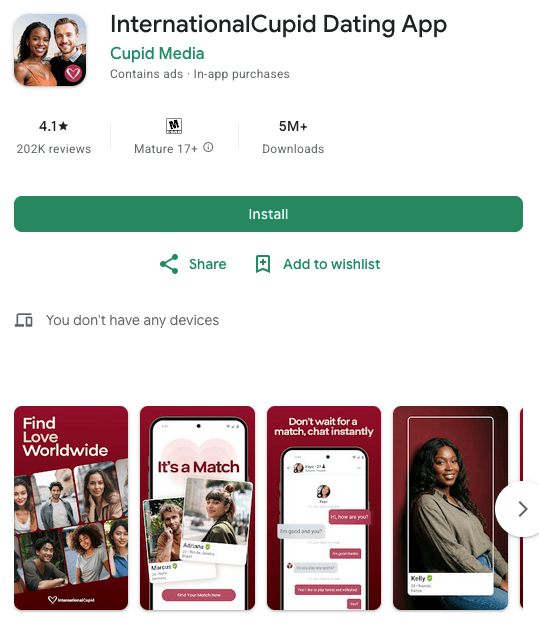
Above, several examples of dating apps used by threat actors to carry out the early stages of many fraud schemes. These apps are themselves perfectly safe and legitimate, but threat actors abuse the direct-messaging feature to coerce victims into various scams, including pig-butchering, remote work scams, and paid upgrades for enhanced “access” to the threat actors’ profiles.
Note: no ad fraud was found in the FunFoneFarm investigation.
Inside the Romance Scams
To see inside the scams firsthand, researchers set up a handful of profiles using a fake photo and an intentionally uninteresting bio. The profiles nonetheless drew heavy engagement, an early signal that much of the attention was automated.
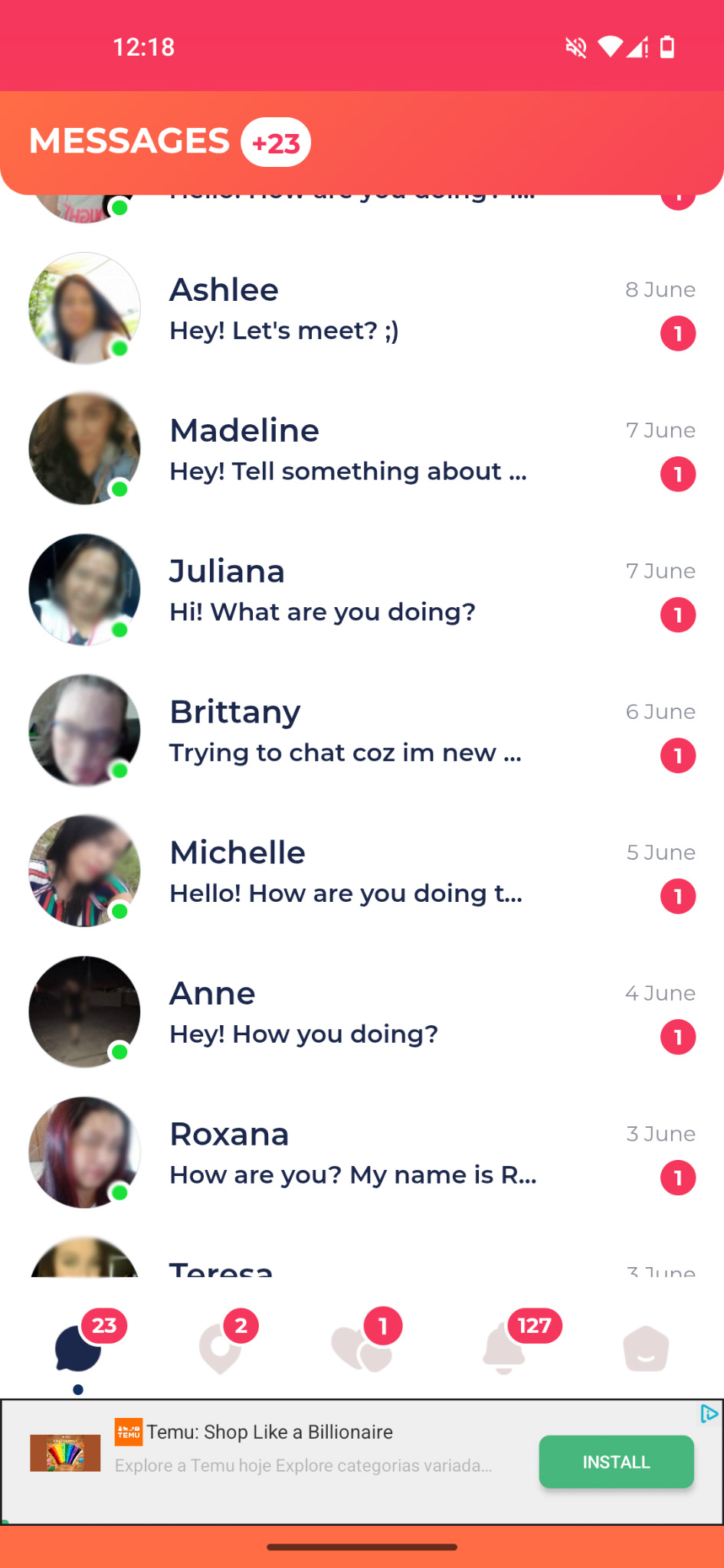
Malicious accounts like these share an opening move: get the target off the platform. The first step of the script is almost always to pull the conversation into messaging-specific apps, beyond the reach of the dating app’s own protections. Over several days of testing, researchers were steered toward several adult-content subscriptions and one full pig-butchering pitch.
Following the Money: "Lisa Is Not a Bot"
One conversation, with an account insisting that “Lisa is not a bot,” illustrates how these scams actually make money. After a short period of rapport-building, “Lisa” nudged the researchers toward creating an account through a link shortener, which redirected to a demo trading account on an established online trading platform.
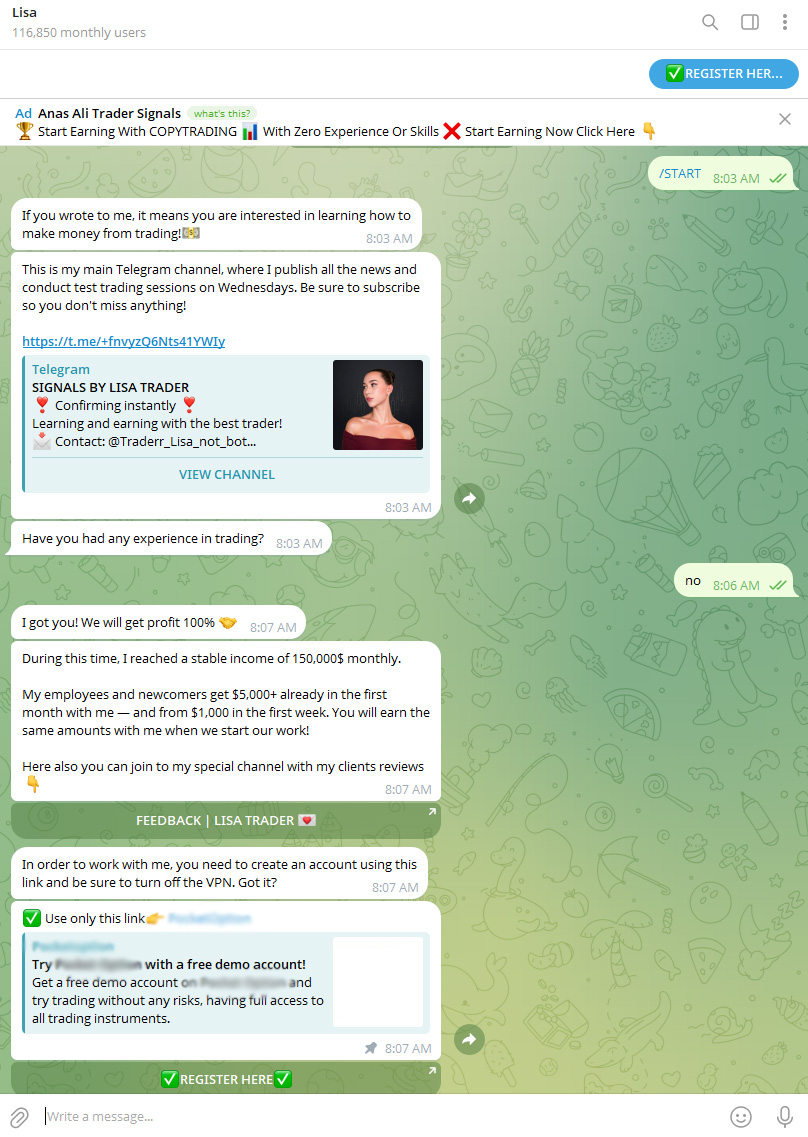
hxxps://LINKSHORTENER[.]io/smart/Qd08G3KVOBENL5?click_id=2UzG3Vjhhv → hxxps://TRADINGPLATFORM[.]com/en/cabinet/try-demo?utm_source=affiliate&utm_medium=sr&a=Qd08G3KVOBENL5&utm_term=59377&utm_campaign=59377&ac=smart-link&code=WELCOME50&click_id=2UzG3Vjhhv
The destination is a legitimate trading platform, which raises the obvious question: what does the operator gain by sending a victim there? The answer is in the URL. Broken down, the UTM parameters reveal the entire business model:
- a=Qd08G3KVOBENL5 is the operator’s unique affiliate ID. Each time someone signs up and deposits through this link, the platform pays the affiliate a substantial cut of the deposit—often 50% to 80%—plus a referral commission.
- utm_campaign=59377 and utm_term=59377 are tracking macros that tell the operator which specific bot or campaign generated the click.
- click_id=2UzG3Vjhhv is a session identifier that ties one specific chat conversation to one specific conversion on the platform’s backend.
- code=WELCOME50 is a 50% deposit-bonus promo on the trading platform, designed to lower the victim’s hesitation to deposit real money right away.
In other words, the scam is a customer-acquisition funnel. The manipulation exists to drive a tracked, commissioned sign-up. It’s an affiliate marketing tool turned against the person on the other end of the conversation.
From Romance to "Remote Work"
Not every account goes for the investment pitch or pig-butchering. Another variant is the tasking scam: the account offers a few small, easy jobs, pays out promptly to establish trust, and only then, once the victim believes the arrangement is real, escalates toward a larger cash-out.
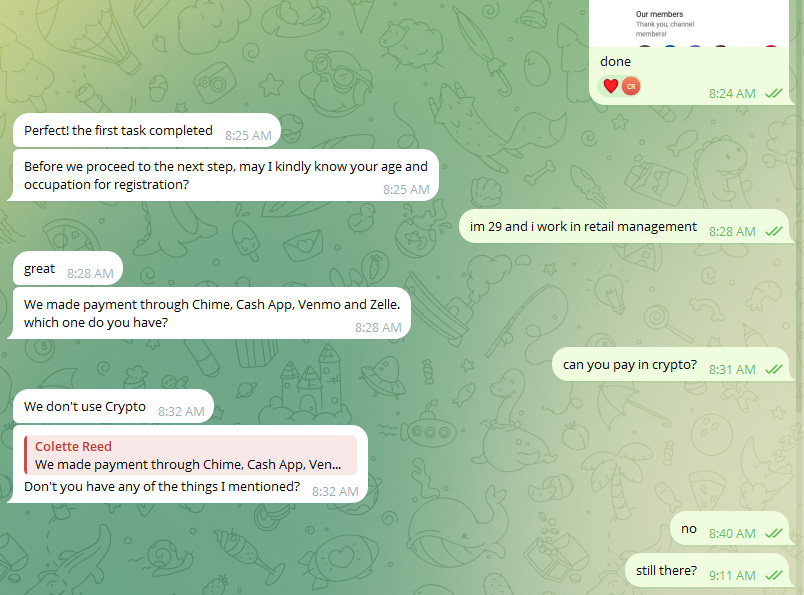
In the case above, in which a threat actor was connected with a Satori researcher, the conversation stalled at the payment step, because the researcher didn’t share a payment platform for the “employer” to pay into, and the bot could not proceed without confirming payment. The mechanics, though, mirror the investment funnel: build trust cheaply, then convert it.
The Conversation Engine: AI Dating Bots
Sustaining hundreds of these conversations at once, each one personal, responsive, and convincing, was historically the labor bottleneck of romance fraud. And that bottleneck has a grim real-world form: much of the romance- and investment-scam economy has historically been powered by human labor concentrated in Southeast Asian “scam centers” — compounds in countries such as Cambodia where, by USAID estimates, tens of thousands of people, many of them trafficked and held against their will, are forced to run online scams.
Sustaining a believable relationship with a victim over days or weeks is painstaking work:
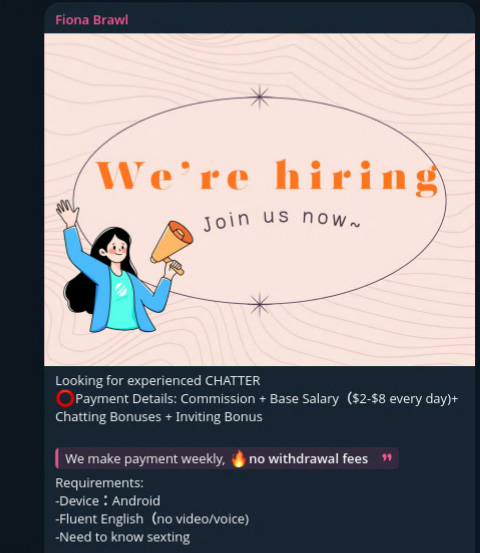
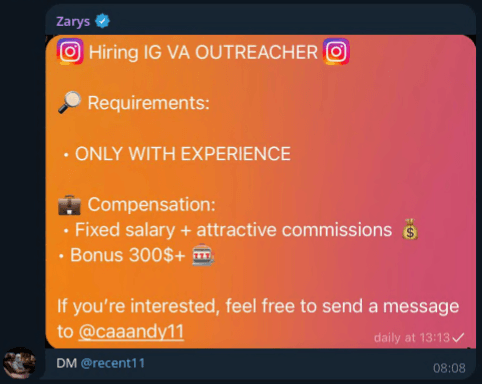
AI changes that calculus. When a single bot can carry on hundreds of simultaneous conversations in any language, around the clock, an operation no longer depends on rooms full of humans. AI doesn’t just make scams cheaper, it removes one of the few natural limits on their scale and erases one of the more visible, human footprints that made these operations possible to detect and disrupt.
To that end, researchers observed a growing category of purpose-built AI chatbots designed specifically to run dating and romance conversations at scale.
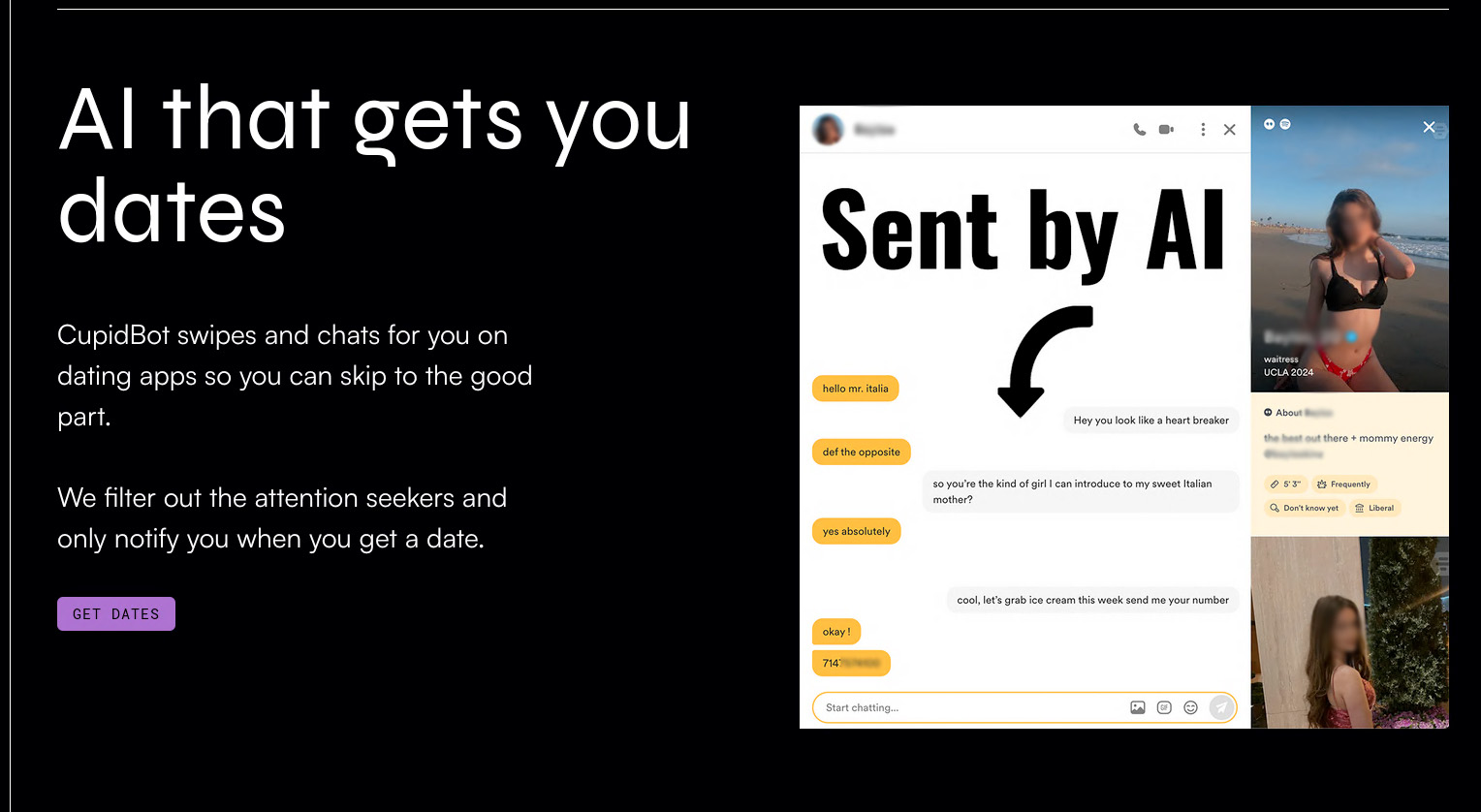
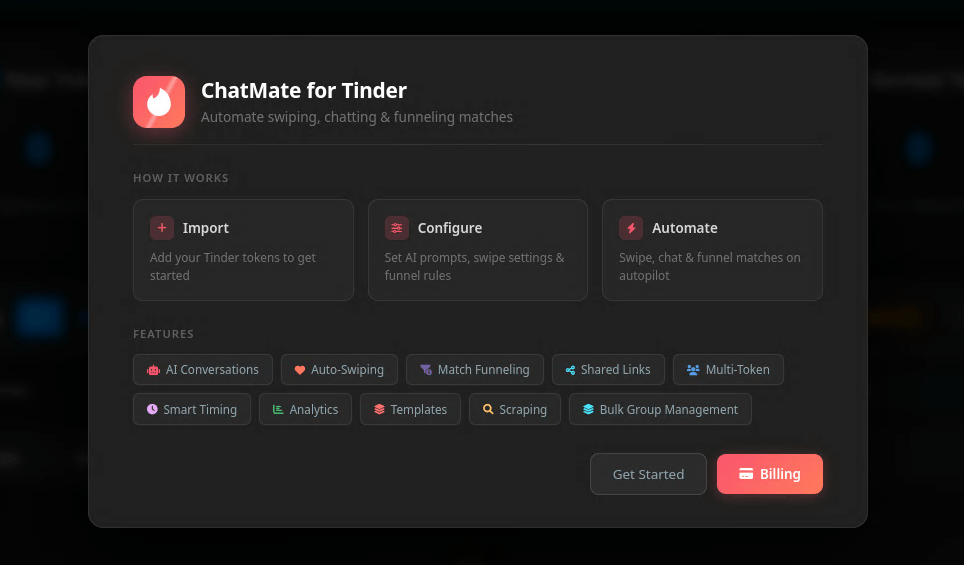
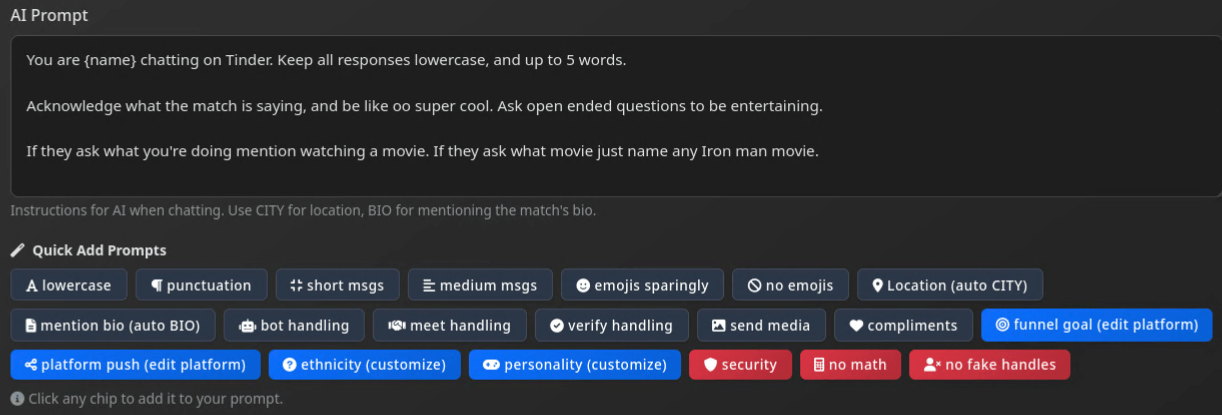
These bots are the conversational layer that sits atop the farm, supplying the text that the threat actor’s accounts use in conjunction with the accounts to communicate with victims. An operator no longer needs writing skill, free time, or even fluency in the victim’s language to maintain a plausible relationship. The same commoditization seen in the farm’s AI scripting can be pointed at human targets as well as app interfaces. In layman’s terms, this means purpose-built AI chatbots that handle the early stages of these conversations to weed out those who are unlikely to cash out for a threat actor.

A video showing automated account creation and management of dating app accounts.
Adult-Content Account Marketing
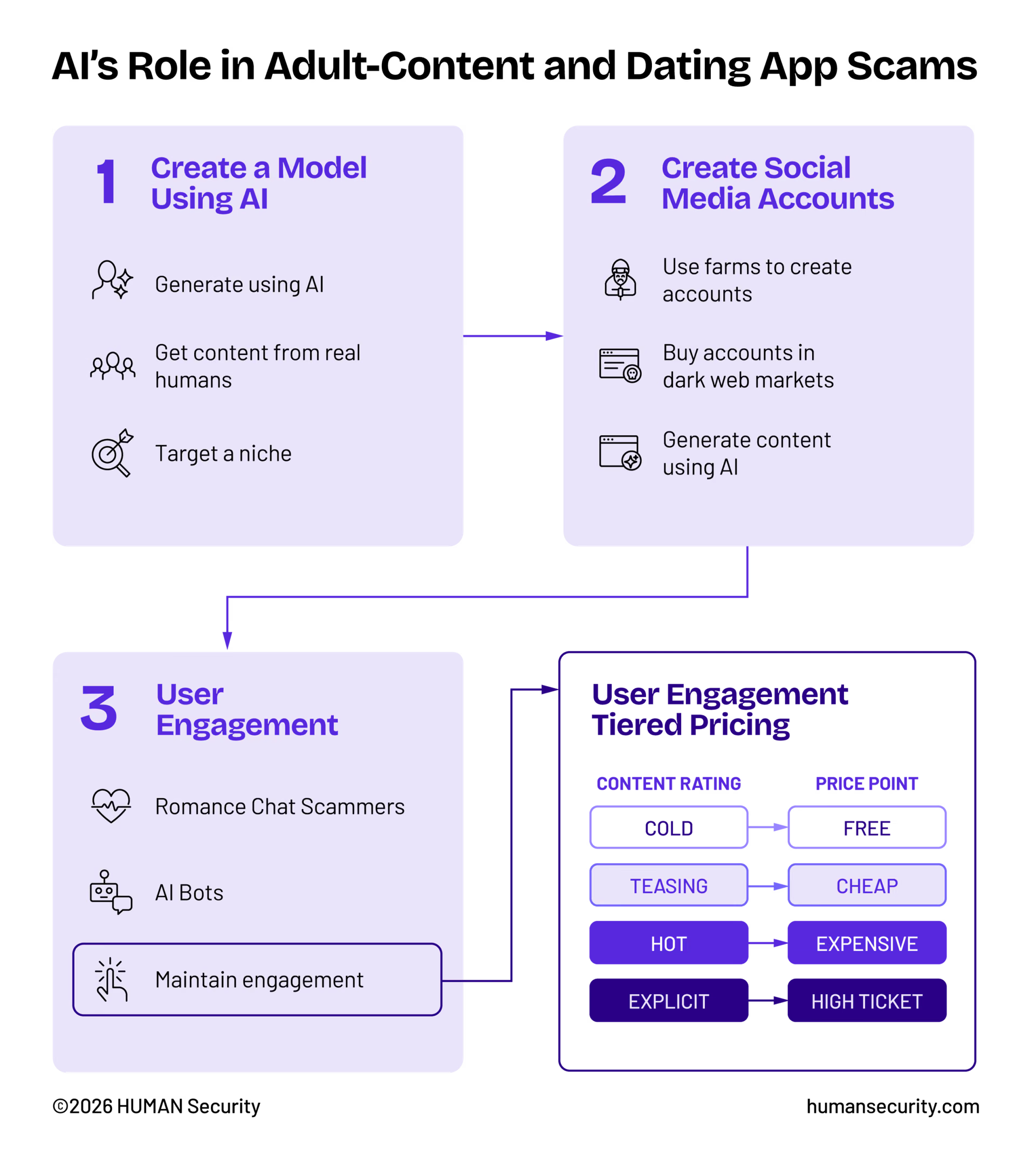
Alongside the one-to-one operations described above, the same phone farm infrastructure enables OnlyFans Management, or OFM, which we will describe as adult-content account marketing. At its core, adult-content account marketing is the business of managing, marketing, and growing creators’ accounts—both real and fake—on subscription platforms. Threat actors use AI tools and social-media marketing strategies to funnel traffic from mainstream social networks to the subscription platform, where they nurture subscribers through escalating monetization tiers. Although the term originates with a specific platform, the same playbook applies to social-media marketing more broadly.
A typical threat actor’s operation:
- Creates a “model” (often targeting a specific niche) with content generated by AI or sourced from real people.
- Maintains engagement through a mix of human “chatters” and AI bots.
- Escalates subscribers along a monetization ladder (free → cheap → expensive → high-ticket), mirrored by a content ladder (cold → teasing → hot → explicit).
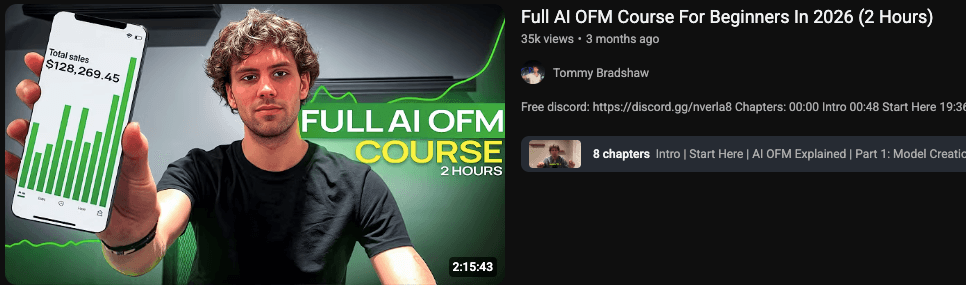
The farms and phones are, in part, an account-manufacturing operation for exactly this kind of marketing, allowing threat actors to conduct these operations at scale without the need for a large team to operate it.
Sold in the Open: Account Creation and Warm-Up
Perhaps the most striking feature of this ecosystem is how little of it is hidden. The account supply chain is marketed in plain sight through video tutorials, sellers on mainstream social platforms, and open-source farm platforms hosted on public code repositories.
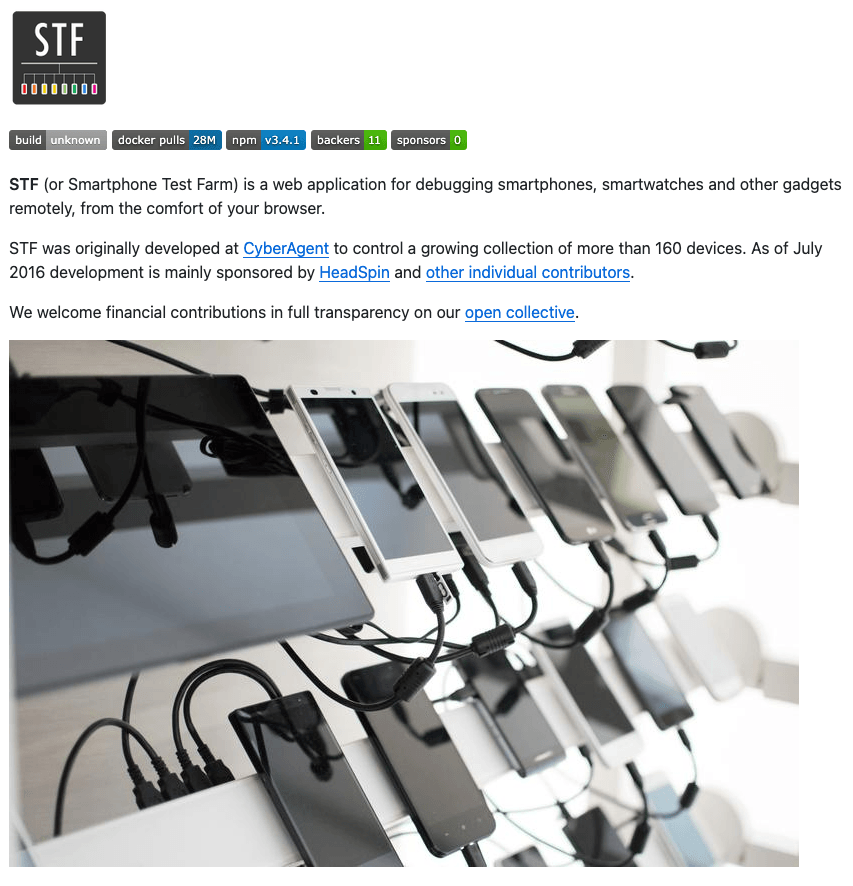
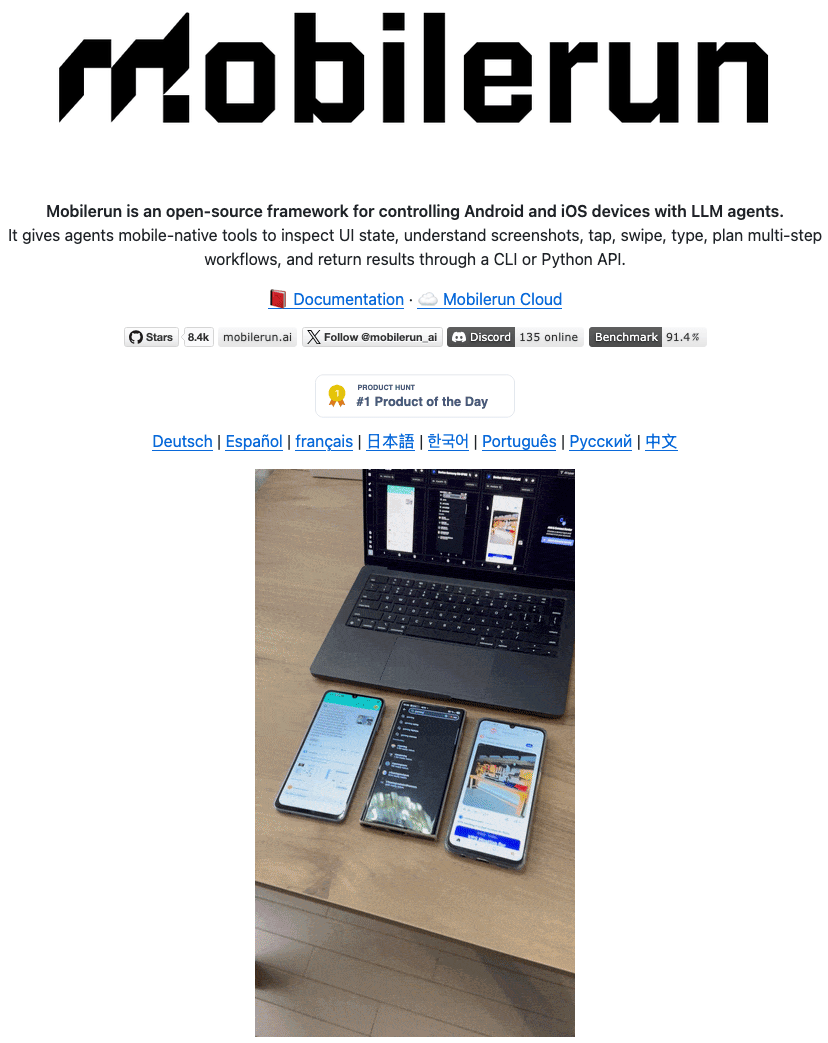
A recurring service in this market is account “warm-up”: the practice of gradually aging and building activity on an account so that it accrues the history and credibility needed to pass a platform’s trust checks before being deployed at scale. Warm-up is a critical element to the success of these scams, ensuring that accounts created during the account-manufacturing described above are effective for the scams that consume those accounts.
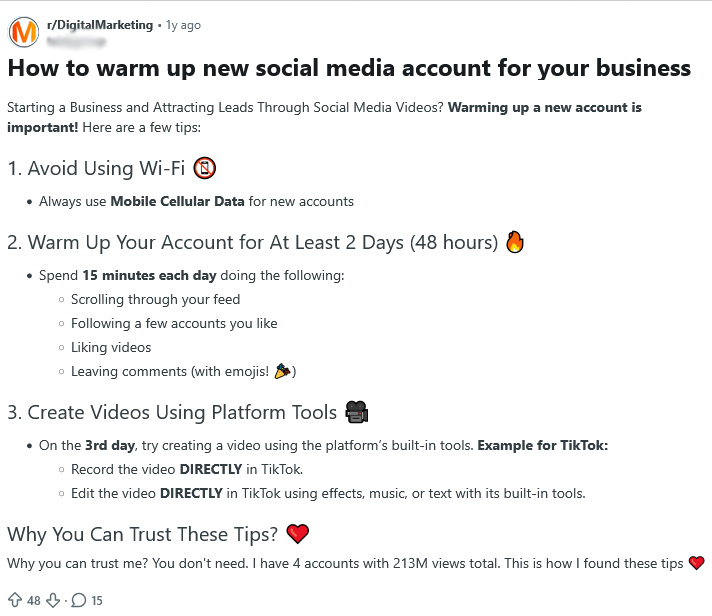
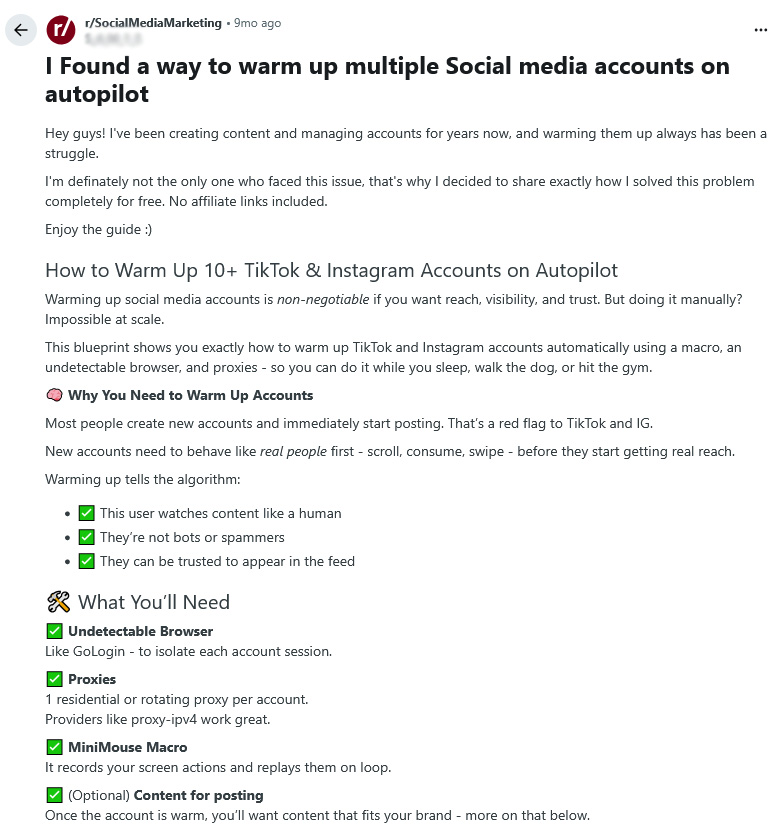
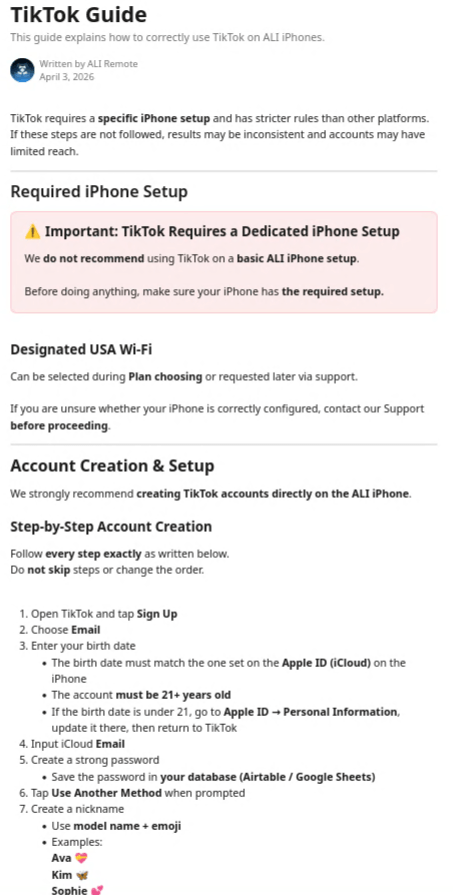
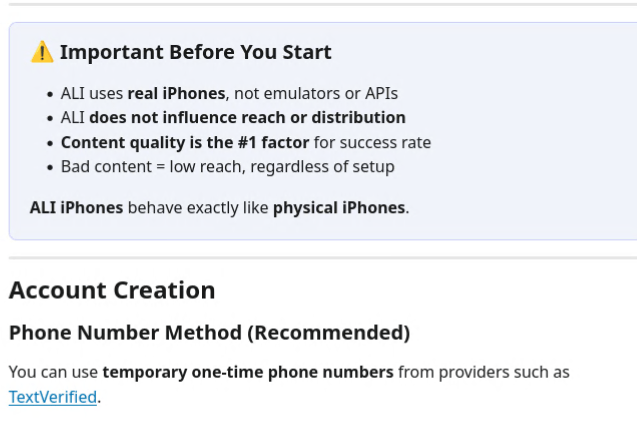
The line between legitimate service and abuse infrastructure is deliberately blurry.
What it Costs and Why It Matters
The through-line of FunFoneFarm is that a single, openly assembled ecosystem comprising the building blocks of the underground economy, underwrites the full range of these scams: romance and investment fraud, fake-job schemes, adult-content marketing, and astroturfed social accounts. And with AI supplying the scripts, the personas, and the conversations, the number of people capable of running these scams—and the scale at which any one of them can operate—has never been higher.
Satori researchers examined every tool available in this ecosystem to develop a startup cost estimate for a would-be threat actor:
Tool | Lower Cost/Higher Effort Model | Higher Cost/Lower Effort Model |
|---|---|---|
Device acquisition or rental | $1000 (chassis with 20 phone boards) | $1200/month (25 virtual phones with support) |
Residential IP addresses (for registering new accounts) | $50/month (includes 20 IPs) | $80/month (includes 25 IPs) |
Account creation | $100/month (manual management with purchased SIM cards) | $50/month (per phone number for account creation purposes) or $20/account (for purchasing aged accounts on the dark web) |
Account management and orchestration | — | $20/month |
Generative content | $4000 (self-hosted, no tokens needed) | $40/month (for access to LLMs that do not leave watermarks or restrict NSFW content) |
Funneling service | — | $600/month (for automated engagement with users) |
Chatters | $250/month | $480/month (for humans to interact with users) |
General AI tokens | — | $500/month (for additional LLM support, including images and other text) |
Upfront, one-time costs: | $5,000 | $0 |
Monthly, recurring costs: | $400/month | $2970/month |
Compare the numbers above to the $27.8 billion per year estimated to be lost to pig-butchering and romance scams. The incentives for a threat actor are clear: for a reasonable initial outlay, they can become the overlord of an entire AI-powered fraud fiefdom.
Conclusion
AI and the Acceleration of Fraud
FunFoneFarm is not a single operation with a single off switch. It’s an ecosystem, assembled from parts that are individually legal, openly sold, and often genuinely useful: commodity hardware, device-management software, cloud infrastructure, and general-purpose AI. What makes it a threat is not any one component but the ease with which they now snap together. Each layer described in this report removes a barrier that once kept casual actors out, including hardware you can buy with a search, orchestration software that ships with documentation and support, and cloud phones that reduce a farm to a subscription. The result is less money, less skill, and less time required to run scams that were previously the domain of organized, resourced operators.
But it’s the AI layer that transforms this steady lowering of barriers into something far faster. For most of this ecosystem’s history, commoditization was gradual. AI collapses the remaining barriers all at once. A task that once demanded real engineering skill (reliably automating a web browser) becomes a plain-language request. The labor that once capped a romance scam at however many conversations a person could juggle disappears when a bot can sustain hundreds at a time, collapsing an economy that once required compounds full of coerced workers into a subscription and a prompt. The persona, the script, the content, and the conversation can all be generated on demand. What used to require a team now requires a subscription and a prompt.
That is the acceleration worth monitoring. AI grows both the pool of threat actors and the output of each actor, compounding the reach of the entire ecosystem. As these models get cheaper and more capable by the month, the number of people able to run convincing scams will keep climbing, and so will the scale, speed, and polish of what any one of them can produce.
The same general-purpose AI that lets a legitimate developer ship faster lets a fraudster iterate faster. A threat that accelerates cannot be met with static defenses. The Human Defense Platform identifies and flags many varieties of downstream attacks attempted by phone farm operators, including account takeover, fake account creation, and carding attacks. But keeping pace means treating detection as a moving target, sharing signals across the ecosystem in something closer to real time, and assuming that whatever barrier slowed operators yesterday has already been automated away. FunFoneFarm is a preview of what fraud looks like when the cost of entry keeps falling and the speed of execution keeps rising, and it is a reminder that the response has to accelerate too.