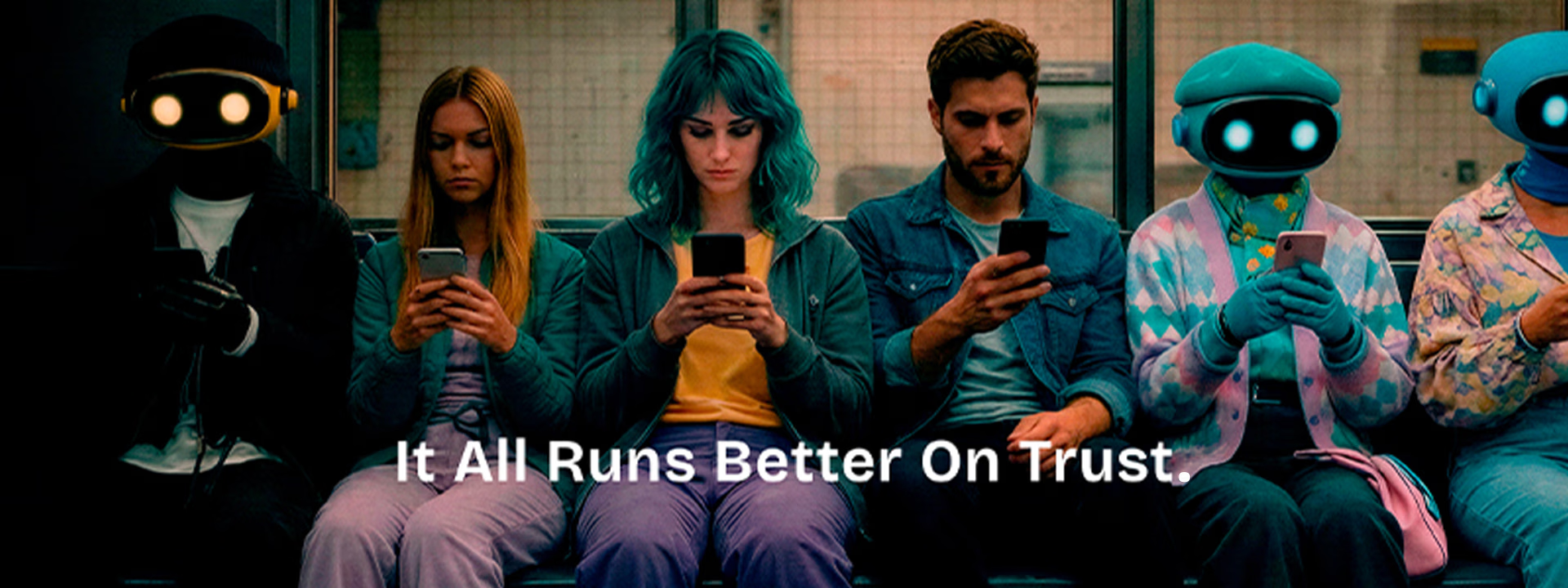
Human society has always organized itself around trust. It’s the foundation beneath language, governance, currency, community, the invisible architecture that makes civilization possible. As more of human life moved online, that necessity followed. For a while, our systems kept up. But the internet has changed again, and this time, the change is more fundamental than anything that came before it. The actors moving through it are no longer mostly human. And the infrastructure we built to establish trust was never designed for that.
The Internet Is No Longer Human-Only
Today, more than half of internet traffic isn’t human. Bots. Scrapers. And now, AI agents, autonomous, capable, operating at machine speed, making decisions on behalf of people and organizations across every vertical we serve. This isn’t a future trend to prepare for. It’s the current operating environment.
And here’s what makes this moment genuinely different from every previous shift we’ve navigated: the challenge is no longer just identifying threats. It’s deciding who, and what, gets to act, and how much trust to extend at every moment. In a world of mixed actors, the old binary of “human or bot” doesn’t give you enough to go on. You need to understand intent. Context. Legitimacy. Not just activity.
That’s a fundamentally different problem. And it requires a fundamentally different approach to solve it.
This Is Not a Pivot
I want to be clear about something, because I’ve seen too many companies in this space try to reinvent themselves as “AI companies” overnight, slapping new language on old capabilities and hoping the market doesn’t notice. That’s not what’s happening here.
HUMAN has spent 14 years building something specific: a detection engine trained on non-human behavior at scale. Quadrillions of interactions. Billions of devices. Our systems didn’t just observe bots — they learned from them, evolved alongside them, built a depth of understanding that simply cannot be quickly or easily replicated. Every wave of automation, every new attack pattern, every novel form of synthetic activity has made us sharper.
AI agents aren’t a departure from that work. They’re its continuation. The latest evolution of the problem we’ve always been solving.
What’s new is the scope… and the stakes.
What This Moment Demands
When trust fractures at internet scale, the consequences aren’t abstract. Markets question themselves. Media loses authority. Commerce slows. Decisions get made on corrupted signals. The compounding effects touch every business we serve and every person those businesses serve.
The world needs someone to be the trust layer of the internet, to verify who and what gets to act before outcomes become irreversible. To make the mixed internet legible before actions count. To ensure that real customers, trusted partners, and legitimate AI agents can move freely, while fraud, abuse, and bad actors can’t.
That is HUMAN’s job. It has always been HUMAN’s job. And we’ve never been better equipped to do it.
It All Runs Better on Trust
Today, we’re launching a new brand platform that captures this moment and what we believe about it. “It All Runs Better on Trust” isn’t a tagline. It’s a thesis. A statement about the world we’re operating in and the role we intend to play in it.
Commerce runs better on trust. Media runs better on trust. Advertising, marketing, finance, security, customer experience — all of it runs better on trust. And as AI agents become the connective tissue of the digital economy, making sure those agents operate within trusted frameworks isn’t optional. It’s the condition for everything else working.
We built this company because we believed the internet was worth protecting. That belief hasn’t changed. But the scope of what “protecting the internet” means has grown, and we’ve grown with it.
This is a new chapter. We’re ready for it.