
Artificial intelligence is quietly reshaping one of the most familiar rituals of the year: holiday shopping. What was once a season defined by crowded stores and late-night searches is now shaped by algorithms that can recommend, compare, and even purchase gifts on our behalf.
This holiday season marks a shift. It’ll be the first where many consumers will use agentic shopping platforms that act on their behalf. As AI becomes a more active participant in how people browse, buy, and give, businesses need to understand what that shift means for trust, personalization, and online safety.
At HUMAN Security, we wanted to understand how Americans plan to use AI during the holidays, so we surveyed people across the U.S. to find out what kinds of tools they’re embracing, and how these behaviors reflect the intersection between convenience and authenticity online. What we’re seeing across our own data aligns with this shift. More online activity is being influenced by automated tools and AI-driven recommendations, highlighting the growing need for secure digital experiences.
The results from the survey reveal a dramatic shift from last year. More people are turning to AI to ease stress, save time, and make better decisions, even as they weigh what that convenience means for trust and authenticity.
The findings shed light on where AI fits into the modern holiday experience and how quickly it’s moving from optional to expected.
How States Are Embracing AI for Holiday Shopping
The holiday season has been testing people’s patience for decades. Now, increasingly, it’s testing their relationship with technology. For many shoppers, artificial intelligence is becoming a solution to seasonal stress, helping them save time, find ideas, and avoid decision fatigue. But the degree to which people plan to use AI this year varies, with some interesting regional trends popping up.
States Leading the Shift Toward AI-Assisted Shopping
Across the country, 64% of Americans say they plan to use AI tools to help with holiday shopping this year, a remarkable jump from 11% last year. That 53-point rise underscores how rapidly generative AI and agentic browsers are moving from novelty to everyday utility.
Some states stand out for their enthusiasm. In several, the share of people turning to AI for gift ideas has increased more than sixfold in just a year.
These numbers reflect broader national adoption trends. As generative tools integrate into search, browsers, and shopping platforms, more people see them as trusted assistants rather than experimental technology.
Who Americans Need the Most Help Shopping For
Even with help from AI, holiday shopping remains personal and, in many cases, complicated. Some relationships simply require more thought.
When asked who’s hardest to shop for, Americans said:
It’s no surprise that partners and parents top the list. They’re often the people shoppers want to impress most, which means that’s where the margin for a “wrong” gift feels smallest.
That sentiment carries over into AI use. When asked who they’d most likely use AI to shop for:
It makes sense since these are the people Americans most often buy gifts for, but it’s notable how many feel comfortable letting AI assist with gifts for those closest to them, where personalization and creativity often matter most.
States Most Skeptical of AI-Suggested Gifts
While most Americans welcome AI’s role in simplifying the season, not everyone is ready to dive in head first—especially when it comes to gifts that feel impersonal. 12% of Americans said they’d feel negatively if a gift they received had been suggested by AI. But still, 1 in 3 (36%) would feel positively about it, and most (52%) said they wouldn’t care.
Attitudes differ by generation. One in five Gen Zers (20%) said they’d react negatively, while one in four (25%) said they’d react positively. Among baby boomers, only 5% said negative and 46% said positive. If you’re purchasing gifts for younger people in your life, maybe don’t let them know if you’re using AI to do so.
When we zoom in on regional preferences, skepticism is strongest in:
Even so, sentiment toward AI-assisted gifting remains largely neutral or favorable, suggesting people are growing used to the idea of algorithms influencing human decisions, even those tied more closely to emotion and tradition.
The data shows a clear pattern: Americans are learning to delegate some of the more stressful parts of their holiday experience to AI, even as they negotiate what that means for authenticity and connection.
Next, we’ll look closer at how Americans overall are approaching the use of AI this holiday season. Not just what they’re buying, but how these tools are shaping the broader experience of gift-giving.
Your Guide to Safely Adopting Agentic Commerce
See how AI agents are changing discovery and purchase, explore the emerging trust frameworks, and learn what readiness looks like for the agent-driven economy.

How Americans Are Turning to AI for Holiday Help
Across the country, Americans are feeling the familiar holiday pressure. To lessen that this year, more of them are open to letting AI share the load. From finding gifts to comparing prices, generative tools and emerging agentic browsers are becoming part of the seasonal routine.
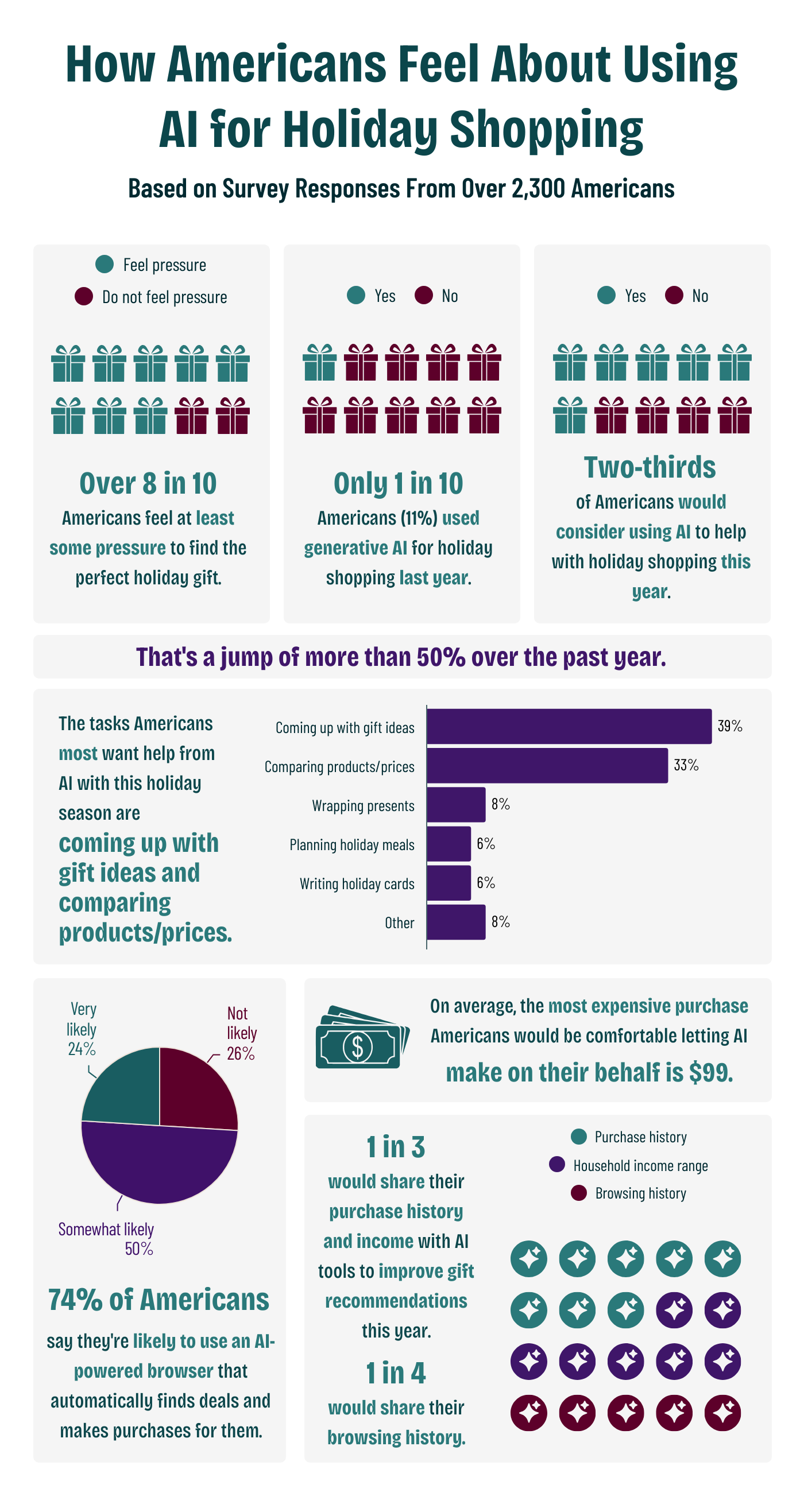
How Americans Feel About Holiday Shopping
Gift-giving still carries weight. 84% of Americans say they feel at least some pressure to find the perfect holiday gift, and only 16% feel none at all. The emotional stakes remain high even as technology promises efficiency.
When asked how they feel about holiday shopping overall:
The balance suggests that most people don’t dread the process, but many would welcome tools that can simplify it. That’s where AI enters the picture.
AI Adoption Is Rising Fast, but Not Evenly
Only 11% of Americans used generative AI for holiday shopping last year, but this year, nearly two-thirds (64%) say they’d consider using AI tools or agents to help. Even among people who’ve never used AI before, one in ten say they’re open to trying it. This surge in consumer openness reflects the broader rise of agentic AI activity online, where traffic from tools like ChatGPT Agent and Perplexity Comet has grown more than 1,300% in 2025.
Interestingly, technology adoption doesn’t follow the typical generational curve. Gen Z respondents were least likely to say they’d use AI for shopping (53%), while Gen X (70%) and baby boomers (64%) were far more willing. Older consumers may be more pragmatic about using AI for transactional tasks, while younger users could see shopping as too personal for automation.
What Americans Want AI To Do
When asked how they’d most like AI to assist this holiday season, respondents pointed to the tasks that consume the most time:
Additionally, nearly two-thirds (63%) say they’d trust AI to act as their “holiday gift guide.” Even among people who rarely use AI, one-third (34%) say they’d be comfortable doing so. The idea of AI as a trusted research assistant is becoming normalized, mirroring broader shifts in how consumers search and evaluate products online.
The data suggests that AI’s perceived value lies in decision support, if not total delegation just yet. Shoppers are open to recommendations, but may still want to make final choices themselves. Though that, too, could be changing.
The Rise of Agentic Browsers
A new category of tools—agentic browsers that can autonomously find discounts, compare prices, and even complete purchases—is also gaining attention. 74% of Americans say they’re at least somewhat likely to use one, including 25% who say they’re very likely.
Interest rises sharply among regular AI users:
Convenience is clearly driving curiosity, but there are limits. On average, Americans say the most expensive purchase they’d be comfortable letting AI make for them is $99. A fairly modest threshold that shows lingering caution around financial automation, especially for the largest of purchases.
What People Are Willing To Share
Trust also extends to data sharing, though with boundaries. As more shoppers test these autonomous tools, their willingness to share data becomes a key factor.
These figures point to a shifting relationship between privacy and personalization. As AI becomes embedded in more shopping platforms, transparency about data use will shape how quickly consumers deepen that trust.
The national data reflects a population in transition. Still a bit wary of handing off total control, but increasingly open to letting AI streamline decisions. Holiday shopping, once defined by in-person searching and impulse buys, is becoming a digital collaboration between human intuition and machine assistance.
Closing Thoughts
The holidays highlight how quickly AI is becoming part of everyday decision-making. What began as experimental use last year is now routine for many shoppers, and the rise of agentic browsers shows how automation is moving from suggestion to action.
For organizations, this shift underscores a broader truth: as AI takes on more responsibility in digital interactions, maintaining trust and authenticity becomes essential. Every automated action, from browsing to buying, still depends on a secure, human-first foundation.
For companies navigating this shift, HUMAN’s Guide to Adopting Agentic Commerce offers practical steps for integrating agentic technologies responsibly while maintaining consumer trust. With solutions like AgenticTrust, HUMAN enables organizations to detect and classify AI agents, verify their trust level, and govern how they interact with applications. By providing real-time visibility into agent intent and behavior and helping prevent spoofed or malicious agents, HUMAN ensures that as AI agents play a larger role in the online journey, they do so safely, transparently, and within the boundaries businesses define.
Methodology
To get insight into how and why Americans plan on using artificial intelligence (AI) during the holidays, we surveyed people from every state, asking them about their holiday stress levels, their use of AI for holiday shopping, how they feel about AI use during the holidays, and what role they expect automated shopping to play this year.
We analyzed a few key data points by state to view regional disparities in AI use during the holiday season. Our sample included respondents who ranged from daily AI users to those who have only heard of it.
The data is based on over 2,300 survey respondents. States not included due to insufficient survey respondents: Alaska, North Dakota, and Wyoming.
Fair Use
You are welcome to use, reference, and share non-commercial excerpts of this study with proper attribution. If you cite or cover our findings, please link back to this page so readers can view the full methodology, charts, and context.
Get visibility and control over AI agents and agentic browsers on your website.